
Here's the problem: many organizations pull a generic IAM metrics template, assume it applies universally, and call it a risk program. It doesn't work that way. What counts as a red flag in a bank's SoD violation is background noise in a manufacturing plant. A three-day clinician onboarding delay is a patient-care risk in healthcare; almost anywhere else, it's just a KPI miss.
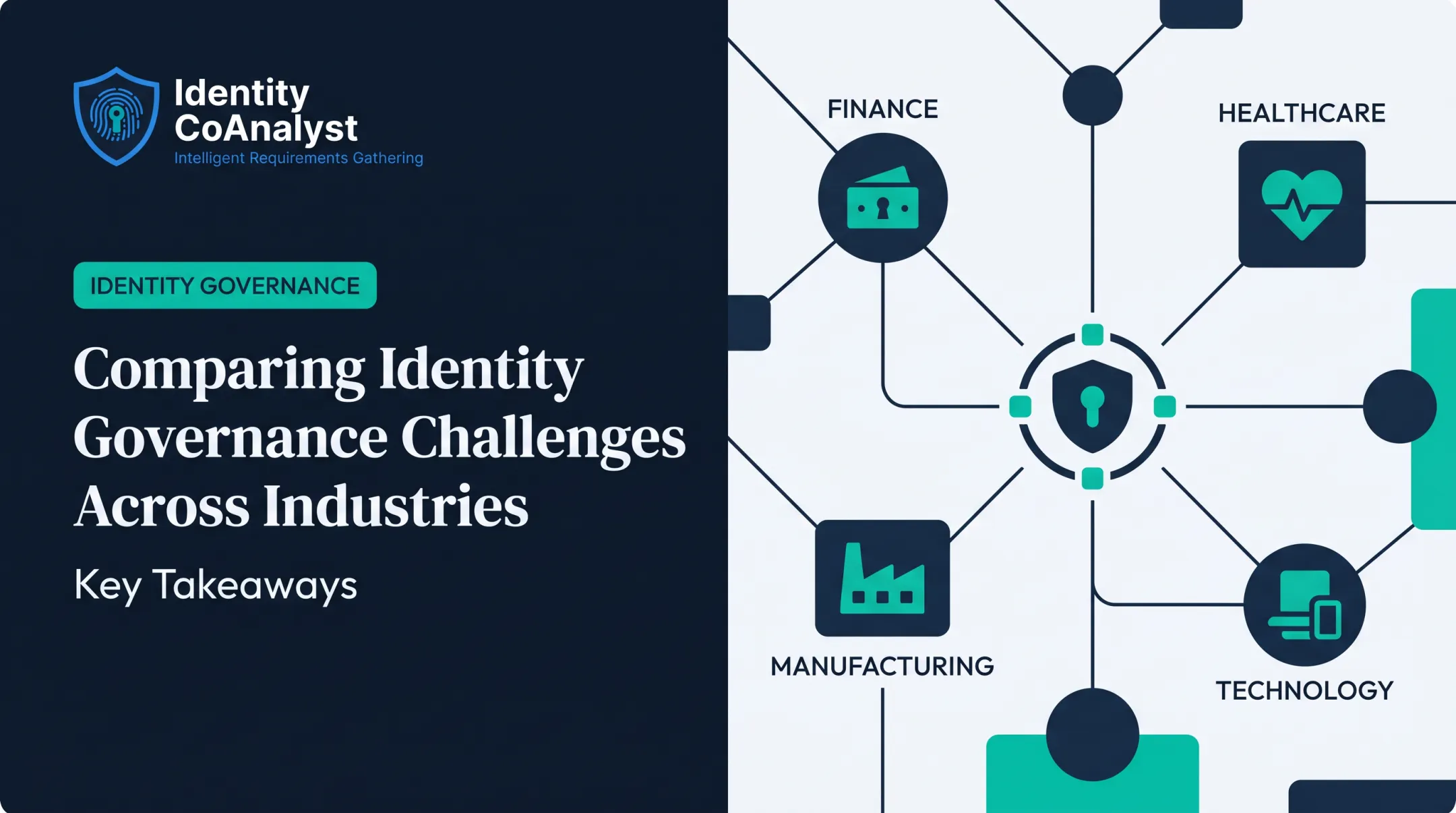
Identity-related risk carries real weight. IBM's 2026 Cost of a Data Breach Report puts the global average cost of a data breach at $4.99 million, and Verizon's 2026 DBIR found credentials involved in 28% of breaches overall, with stolen credentials appearing in 65% of hacking-related breaches. This article compares how healthcare, financial services, government, legal, pharma, energy, manufacturing, and higher education each define "risky" differently, and why that distinction matters when you're building an IAM program.
Key Takeaways
- KPIs measure operational efficiency; KRIs warn you before a control fails
- Regulated sectors (healthcare, finance, federal) have mature, compliance-driven KRI thresholds — others are still catching up
- Orphaned accounts and SoD violations exist everywhere, but "acceptable" varies wildly by sector
- Non-human identities and vendor access are now universal blind spots
- Getting KRIs right starts at requirements gathering, not after go-live
What Is the Difference Between IAM KPIs and KRIs?
IAM programs love to track everything and call it "governance." But not every metric tells you the same thing.
A KPI measures how well IAM operations run: think time-to-provision or access-request SLA attainment. ISACA describes KPIs as quantifiable measures of performance toward a specific objective. A fast provisioning time looks great on a slide.
A KRI is different. It's an early warning that your risk exposure is climbing toward or past your appetite for it. ISACA's framework defines it as a signal of increased exposure, not a performance grade.
Here's where it gets tricky: the same data point can be both.
- Access certification completion rate is a KPI when you're measuring team throughput.
- The same number is a KRI when a low completion rate signals governance decay and unreviewed access sitting live in your systems.
Framing changes everything. Report certification completion as a KPI, and 87% looks solid. Frame it as a KRI, and that remaining 13% might include your most privileged accounts.
Organizations that blur this line end up reporting "strong performance" while actual risk exposure builds underneath the dashboard.
Core IAM KRIs Common Across All Industries
Before comparing sectors, here's the baseline set that matters everywhere, though what counts as "acceptable" shifts industry to industry. No authoritative source sets universal percentage thresholds ; define yours based on risk appetite and asset criticality.
- Orphaned and uncorrelated accounts: dormant access left behind after role changes or departures. No account should exist without a traceable, active owner.
- Segregation of Duties (SoD) violations: conflicting permissions that let one person create and approve the same transaction, common in finance-adjacent workflows. PCAOB guidance flags excessive IT access as a direct SoD risk.
- Privileged accounts without a clear owner: admin-level access nobody's watching is the highest-value target for insiders and attackers.
- Access review/certification completion rate: incomplete recertification campaigns, especially skipped high-risk reviews, signal governance decay.
- Time-to-deprovision departed users: every day a former employee's credentials stay active adds unnecessary insider-threat exposure. NIST SP 800-53 AC-2(3) requires disabling accounts within an organization-defined period.
- Non-human and machine identity sprawl: service accounts, API keys, and workload identities often outnumber human users, and most organizations can't name their owners.
Machine identities deserve special weight. Gartner's 2025 machine-identity research notes that inadequate machine-identity security creates outsized risk because these identities often carry extensive, unmonitored privileges.

Comparing IAM Key Risk Indicators Across Major Industries
Healthcare Organizations and Hospital Networks
HIPAA's Security Rule requires access-control policies that limit ePHI access strictly to authorized roles, unique user identification, and automatic logoff. That drives a signature healthcare KRI: number of users with unnecessary access to patient records, often tied to HHS's minimum-necessary standard.
Clinician onboarding speed is a KRI here, not just a KPI. In most industries, slow provisioning is an efficiency complaint. In a hospital, delayed access can delay patient care. That reframes a routine operational metric into a risk indicator with clinical consequences.
Financial Services Organizations
SOX compliance and fraud exposure push financial services toward heavy emphasis on SoD violations and privileged transaction monitoring. PCAOB's AS 2110 specifically identifies IT access beyond assigned duties as a control-breakdown risk.
Orphaned privileged accounts get much stricter scrutiny here than elsewhere, largely because of examination pressure from regulators like the OCC and FFIEC. A dormant admin account that might sit unnoticed for months in manufacturing would trigger immediate remediation in banking.

Federal Government Organizations
Federal agencies operate under FISMA and NIST SP 800-53, which shifts the KRI focus toward continuous monitoring rather than periodic review. Key indicators include unauthorized access attempts and PIV credential compliance. OMB Memorandum M-19-17 requires PIV credentials as the primary access method for executive agencies.
NIST's AC-2 and AC-6 controls also formalize least-privilege and account-lifecycle requirements, though the specific time periods for disabling inactive accounts are organization-defined rather than fixed by a single government-wide number.
Legal, Pharma/Biotech, Energy/Utilities, Manufacturing, and Higher Education
| Industry | Signature KRIs | Relative Risk Tolerance |
|---|---|---|
| Legal | Client-matter access segregation; ethical-wall (conflict-of-interest) violations | Low (ABA Model Rule 1.6(c)) |
| Pharma/Biotech | Research data access controls; 21 CFR Part 11 audit-trail gaps | Low (GxP and IP protection) |
| Energy/Utilities | Privileged access to industrial control systems; OT/IT convergence gaps | Low (NERC CIP-004/005) |
| Manufacturing | Third-party/vendor access sprawl; privileged access creep | Moderate (less regulatory pressure; rising OT exposure) |
| Higher Education | Student/faculty account sprawl; guest and contractor access | Moderate-to-high (broad populations; FERPA) |
A few sector nuances sit behind those rows:
- Legal: One attorney's access to a matter can create a malpractice and conflict issue, not only a data exposure.
- Pharma/Biotech: KRIs map to FDA data-integrity rules on audit trails and authorized-user access.
- Energy/Utilities: OT/IT convergence means a compromised credential can affect physical infrastructure, not just data.
- Manufacturing and higher ed: Vendor sprawl, guest access, and large transient populations raise exposure even when formal regulatory pressure is lighter than in banking or healthcare.

Why These Differences Exist and What They Mean for Your IAM Program
Regulatory frameworks define which KRIs matter; they do not merely suggest them. HIPAA, SOX, FISMA, NERC CIP, and GxP each specify what "controlled access" looks like in their domain. That is why a bank's SoD threshold and a university's account-sprawl tolerance sit at opposite ends of the spectrum.
Industries facing less direct regulatory pressure — manufacturing, higher education — often under-invest in KRI tracking until an incident forces the issue. That reactive posture is expensive: programs get built after a breach, not before one.
For your IAM program, those differences translate into a few practical moves:
- Benchmark KRIs against industry peers, not generic best-practice lists
- Prioritize metrics that map to your primary regulatory obligations
- Stand up KRI tracking before an incident, especially in lighter-touch sectors
One trend still cuts across every sector regardless of regulation: non-human identities and third-party vendor access. Service accounts, API keys, and contractor credentials do not respect industry boundaries. Every organization in this article, from hospitals to power utilities, is accumulating machine identities faster than it can govern them.
Building an Industry-Accurate KRI Program from Day One
Most IAM programs don't fail because teams can't track KRIs. They fail because nobody defined the right KRIs during initial requirements gathering. Generic templates ask generic questions — they miss the ethical-wall nuance in legal, the OT convergence risk in energy, the minimum-necessary standard in healthcare. Manual stakeholder interviews try to fill that gap, but they're slow and inconsistent. One interviewer asks about SoD; another forgets to ask about emergency access procedures. Contradictions between stakeholders go unnoticed until an auditor finds them. Identity CoAnalyst replaces ad hoc interviews and spreadsheets with 500+ practitioner-written questions across 11 identity domains. It surfaces governance context and compliance requirements upfront, including:

- Access certifications and lifecycle events
- Privileged access management
- Identity modeling and SoD controls
- Branching probes that adapt by industry and role The conversational format adjusts based on how stakeholders answer. A healthcare client gets questions on PHI access nuances that a manufacturing client never sees. Output is vendor-agnostic, implementation-ready requirements documentation that works upstream of SailPoint, Saviynt, CyberArk, and similar platforms. A KRI is only as good as the requirement behind it. If discovery misses a sector-specific risk during design, no dashboard built later will catch it. Boutique IAM firms can run a no-cost pilot on an active engagement, using their own stakeholders rather than a sandbox demo.
Frequently Asked Questions
What are the key metrics for identity and access management?
Core categories include authentication (MFA adoption, failed login attempts), access governance (certification completion, SoD violations), privileged access management (unowned admin accounts), and operational metrics like provisioning time. Which ones matter most depends on your industry’s risk profile and regulatory pressure.
What are the 5 pillars of IAM?
The five pillars are identity governance, access management, authentication, privileged access management, and identity lifecycle/provisioning. Together they cover how identities are created, verified, granted access, monitored, and retired.
How often should IAM KRIs be reviewed compared to KPIs?
High-risk KRIs like privileged access exposure often need monthly or continuous monitoring, especially in regulated sectors. KPIs, which track operational efficiency, are typically fine on a quarterly review cycle.
Do KRIs need to be different for every industry, or is there a universal set?
A common baseline exists — orphaned accounts, SoD violations, unowned privileged access — but thresholds and priority ordering shift based on your regulatory environment and operational risk profile.
How do organizations decide which KRIs to prioritize during an IAM project?
Prioritization should come from structured requirements gathering that captures regulatory context, stakeholder risk tolerance, and existing control gaps. Platforms like Identity CoAnalyst help teams run that discovery consistently so KRI programs reflect real risk—not generic templates.