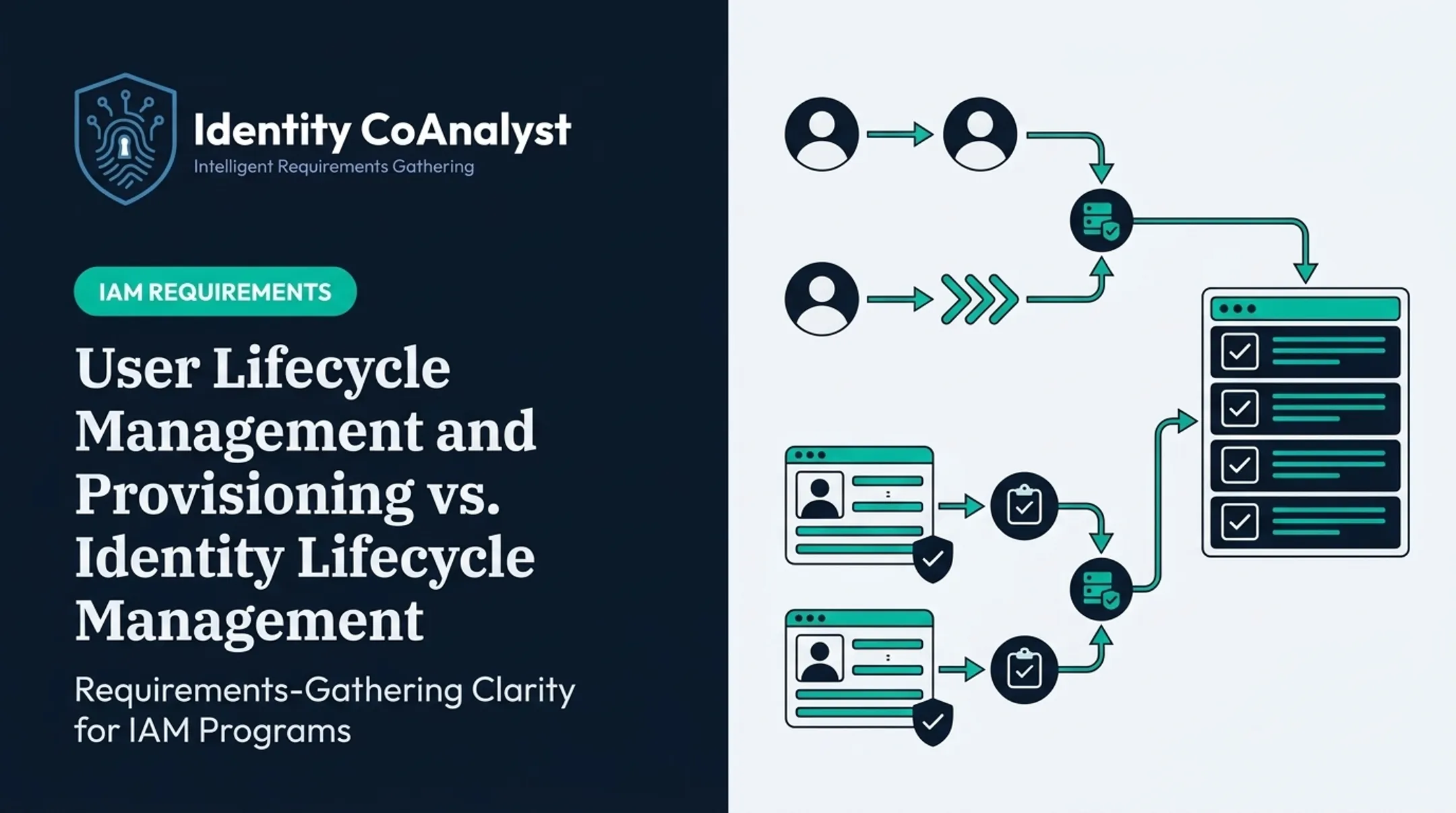

The distinction isn't academic. It determines which vendor you shortlist, how many weeks you allocate to discovery, and who on your team owns the outcome. This article breaks down what each term actually means, where they overlap, and how to figure out which one your organization needs first.
TL;DR
- IDM manages digital identity lifecycles: creation, roles, attributes, deactivation
- IAM governs authentication, authorization, and ongoing access on top of that identity data
- IDM answers "who is this person," IAM answers "what can they do, right now"
- Mature programs run both: IDM for identity lifecycle, IAM for access control
- Start where the bigger gap is: identity data quality or access control
IDM vs IAM: Quick Comparison
| Dimension | IDM | IAM |
|---|---|---|
| Primary focus | Creating, maintaining, retiring digital identities | Authenticating and authorizing access in real time |
| Scope | Identity data, roles, attributes, lifecycle states | Full framework: IDM plus authentication and authorization |
| When it operates | Before access occurs — onboarding, offboarding | At the moment of access, continuously |
| Core technologies | Directory services, HR-driven provisioning, identity repositories | SSO, MFA, role-based access control, policy engines |
| Typical owner | HR/IT identity teams | Security/IT operations teams |
In short, IDM manages who someone is; IAM decides what they can do. NIST frames IAM as a fundamental cybersecurity capability: the right people and systems get the right access to the right resources at the right time. IDM is the administrative layer underneath that makes those access decisions possible.

What Is IDM (Identity Management)?
IDM is the practice of creating, maintaining, and retiring digital identities and their attributes across your organization. It's the system of record for "who exists in our environment" — not what they're allowed to touch.
Core components include:
- Identity creation and provisioning
- Role and attribute management
- Lifecycle management (hire to retire)
- Directory integration with HR and IT systems
Done well, IDM eliminates manual onboarding errors, keeps identity data consistent across systems, and gives auditors a clean trail to follow. Done poorly, you end up with duplicate accounts, orphaned users, and a compliance headache.
Use Cases of IDM
IDM is most valuable when identity data itself is the problem:
- Employee onboarding automation — new hires get accounts and role-based attributes assigned without manual ticket-routing
- Mergers and acquisitions — consolidating identity records from two separate directories into one
- Regulated industries — where clean, auditable identity records aren't optional
A March 2023 Forrester study modeled the payoff: password-reset requests dropped 75%, from 500 monthly requests at roughly $25 each, after deploying automated identity lifecycle tools. That's a commissioned, composite model rather than a universal benchmark, but it illustrates why lifecycle automation pays for itself quickly in help-desk savings alone.

What Is IAM (Identity and Access Management)?
IAM is the unified framework that combines identity data with real-time authentication and authorization decisions. It builds on IDM's foundation, then adds the layer that decides, in the moment, whether access gets granted.
Core components include:
- Single sign-on (SSO)
- Multi-factor authentication (MFA)
- Policy-based access control
- Fine-grained cloud/SaaS permissions
IAM enforces least-privilege access, reduces orphaned accounts, and centralizes audit visibility across your entire application landscape. IAM is a broader umbrella than IGA (Identity Governance and Administration) or PAM (Privileged Access Management). Those are specialized layers within the larger discipline, not synonyms for it.
Use Cases of IAM
IAM matters most when access risk, not identity data quality, is the immediate problem:
- Enforcing MFA for sensitive applications based on role, device posture, or location
- Managing consistent access policy across hybrid or multi-cloud environments with dozens of SaaS tools
- Reducing standing access that no longer matches current job function
Microsoft's own security research found that MFA blocks over 99.9% of account-compromise attacks. That figure applies to MFA as a control, not to any full IAM suite. Still, it is strong evidence that runtime access controls deserve investment on their own merit.

IDM vs IAM: Which Do You Need?
Before picking a platform, weigh these factors:
- Regulatory requirements — how strict is your audit trail obligation?
- Number of systems and applications — the more sprawl, the more IAM complexity
- Onboarding/offboarding complexity — high turnover environments lean toward IDM
- Existing IT infrastructure — what's already in place, and what's duct-taped together?
A simple rule of thumb:
- If identity data is fragmented across HR and IT systems, prioritize IDM first
- If access control and authentication gaps are your immediate risk, prioritize IAM
- If both problems exist (they usually do), sequence the work — identity foundation first, access governance second
Here's the part that trips up most projects, regardless of which system you choose: defining accurate requirements upfront determines success more than the platform itself. Roles, entitlements, workflows, and edge cases all need to be nailed down before implementation starts, or you'll be reworking scope three months in.
This is the bottleneck Identity CoAnalyst was built to address. Rather than replacing your IGA, IAM, or PAM platform, it accelerates the discovery phase that comes before any of them get configured.
The platform's questionnaire structure covers both sides of the problem:
- IDM-side: Identity Modeling and Lifecycle Events
- IAM-side: RBAC, Access Requests, and Access Certifications
That split helps stakeholders separate identity data problems from access control problems early, before requirements get muddled.
Conclusion
IDM and IAM aren't competing frameworks. IDM builds the identity foundation; IAM governs access on top of it. Neither one replaces the other, and pretending otherwise is how projects end up rescoped mid-implementation.
The right starting point depends on where your actual gap sits: messy identity data, weak access control, or both. Clear, complete requirements up front reduce implementation delays, audit failures, and expensive rework later.
Traditional IAM, IGA, and PAM discovery commonly runs 8 to 16 weeks. Identity CoAnalyst compresses that same requirements baseline to under 10 days, using 500+ practitioner-written questions across 11 domains, whether the project scope is IDM, IAM, or PAM.

Boutique IAM and IGA specialist firms can try it on a live engagement through a no-cost pilot. No sandbox, no sample data—just real stakeholders and real requirements.
Frequently Asked Questions
What is an identity management (IDM) system?
An IDM system creates, maintains, and retires digital identities and their attributes across an organization. It handles roles, provisioning, and lifecycle events like onboarding and termination.
What does IDM stand for?
IDM stands for Identity Management. It's a narrower, administrative discipline distinct from the broader IAM framework, which also includes authentication and authorization.
What is the difference between IDM and IAM?
IDM manages the identity lifecycle: creating, updating, and retiring accounts. IAM adds real-time authentication and access control on top of that identity data, deciding what someone can actually do.
What is IDM in cybersecurity?
IDM reduces risk by keeping identity data accurate, current, and correctly tied to roles. Clean identity data is the foundation that every downstream access decision depends on.
How are SSO and IDM related?
SSO is an access management feature, not an IDM function; it lets users authenticate once and access multiple resources. But SSO only works reliably when it's built on accurate identity data maintained through IDM.
What is a multi-tenant architecture?
In identity delivery, multi-tenant architecture means one platform serves multiple clients while keeping each client’s identity data isolated. Each tenant manages its own users, permissions, and lifecycle policies independently.