
Here's the problem: authentication alone doesn't tell you whether access is appropriate. It doesn't tell you who approved it, when it should expire, or whether anyone's still using it. A user can log in successfully with credentials that grant far more access than their job requires, and nothing in the login process will flag that.
The numbers back this up. Microsoft's 2023 State of Cloud Permissions Risks report found that less than 5% of permissions granted to workload identities across Azure, AWS, and Google Cloud were actually used.
This article breaks down what a cloud identity governance framework actually contains, from foundational definitions through implementation steps and maturity signals.
Key Takeaways
- A cloud identity governance framework unites policy, people, process, data, and technology across the full identity lifecycle.
- Target outcomes include least privilege, accountable access decisions, timely joiner-mover-leaver changes, separation of duties, and audit-ready evidence.
- Extend coverage past human users to service accounts, workloads, and other machine identities.
- Results hinge on clean identity data, clear ownership, and automation rather than any single tool purchase.
What Is a Cloud Identity Governance Framework?
Cloud identity governance is the structured discipline of deciding, granting, reviewing, changing, and removing access to cloud resources based on business need, risk, policy, and evidence. Tools and dashboards support that work; they do not define it.
A framework is much broader than an IAM configuration. IAM settings tell a system how to authenticate someone. A framework establishes the objectives behind those settings: who owns which decisions, what workflows enforce them, what gets reported, and how the whole thing improves over time.
Untangling IAM, IGA, and PAM
These three terms get used interchangeably, but they're not the same thing:
- IAM authenticates identities and enforces access decisions at runtime. NIST defines it as the administration of individual identities within a system.
- IGA adds the governance layer: lifecycle management, access requests, approvals, certifications, policy and role management, and auditability. Gartner frames IGA as managing the identity lifecycle and governing access across on-premises and cloud environments.
- PAM applies heightened controls to privileged identities and elevated sessions. NIST's NCCoE frames it as monitoring and controlling administrative accounts that carry elevated, often unrestricted access.

The Right Identity, Right Access Model
A mature framework applies one test consistently: the right identity gets the right access to the right resource, at the right time, for the right reason. That test applies equally to a full-time employee, a contractor, a service account, or an automation agent running unattended jobs.
Get this right and you gain:
- Fewer excessive-access findings
- Faster onboarding and offboarding
- Clearer accountability when incidents occur
- Administration that isn't scattered across five cloud consoles
The Key Components of a Cloud Identity Governance Framework
A working framework rests on a handful of interlocking components. Skip one, and the others start to fail.
Governance Foundations: Policy, Data, and Ownership
Before any workflow gets built, someone has to define the rules. That means setting risk tolerance, access principles, control owners, decision rights, exception-handling procedures, and escalation paths.
From there, you need an authoritative identity and entitlement foundation:
- Authoritative sources: HR systems, contractor management tools, directories, and application records that feed accurate identity data
- A complete inventory: users, groups, roles, service accounts, applications, and entitlements, mapped in one place
- Assigned owners: every identity, application, role, and sensitive resource needs a named business or technical owner
Without clean source data, nothing downstream works. One useful pattern from mature identity attribute models: fields like Employee_ID (never reused), Employee_Type (Full-Time, Part-Time, Contractor, Vendor), and Risk_Classification (Standard, Elevated, High) give governance workflows something concrete to act on, rather than vague labels.
Identity Lifecycle Management (Joiner, Mover, Leaver)
Lifecycle triggers should come from authoritative events, not manual tickets.
Typical event paths:
- Joiner: HR status changes to "Active," which creates directory and email accounts and assigns birthright access
- Mover: A department or role change revokes the old role, assigns the new one, and routes existing access to the new manager for recertification—usually within 30 days
- Leaver: Status changes to "Terminated," access is revoked, and accounts are disabled immediately; deletion is often scheduled around 90 days later to preserve audit trails
- Contractor end-date: Warnings at 30 days, 7 days, and near expiry, with automatic revocation the day after the contract ends

Access Controls and Privileged Access
Everyday access decisions run through SSO, MFA, RBAC, and conditional access, with ABAC layered in where role-based models fall short. NIST's RBAC model assigns users to roles and roles to permissions, standardized formally under ANSI/INCITS 359.
High-risk and conflicting access needs sharper controls:
- Separation-of-duties rules: hard-block impossible combinations (for example, a "Purchase Requestor" who is also a "Purchase Approver") with no exceptions
- Soft-blocked combinations: allow exceptions with documented approval, time limits, and enhanced monitoring
- Just-in-time elevation and break-glass procedures: session recording plus mandatory post-access review, often within 24 to 48 hours
Continuous Assurance and Evidence
Governance isn't a one-time setup. It runs on recurring certifications, usage monitoring, and policy-violation detection that produce evidence auditors can actually use.
Certification decisions typically resolve to one of three outcomes: approve with documented business justification, request more information, or revoke. Revocation should trigger automatic removal through provisioning systems.
Review frequency should scale with risk:
- Standard access: annually
- Privileged access: quarterly
- Contractor access: before renewal
- Emergency access: after every use
How to Implement and Operate the Framework
Building this out isn't a single project. It's an operating model you run continuously.
Start With Scope and Risk
Don't try to govern everything on day one. Prioritize:
- Regulated data and production environments
- Privileged roles and critical applications
- High-impact business processes
- Identities holding broad or persistent permissions
Define Who Does What
Assign clear responsibilities across identity teams, application owners, resource owners, managers, HR, security operations, and compliance. Someone has to own each step: request, approve, provision, review, and revoke. When ownership is fuzzy, access sits unreviewed for months.
Standardize the Core Workflows
- Provision access from trusted identity and role attributes wherever possible
- Route exceptions and elevated access through explicit approval chains with expiration dates
- Trigger mover and leaver actions automatically from HR events, not manual requests
- Escalate overdue certifications and unresolved violations instead of letting them age
Document Requirements Before You Buy Technology
This is where most programs stumble. Teams jump straight into vendor selection before documenting:
- Identity sources and target systems
- Lifecycle scenarios and role structures
- Approval rules and certification scope
- Integration needs
This is the discovery phase Identity CoAnalyst was built to support. It's a vendor-agnostic requirements-gathering platform that walks stakeholders through guided, conversational questionnaires and generates implementation-ready requirements documentation—without acting as the enforcement layer itself.
It doesn't replace SailPoint, Saviynt, or Omada. It gives your team clean, complete requirements before you configure any of them.
Measure and Improve
Track these operating metrics:
- Access review completion
- Time to remove leaver access
- Stale-account remediation
- Exception age
- Share of applications with named owners
The gap between good intentions and actual practice is real. The 2024 Ponemon Institute IAM study found only 46% of practitioners rated their platforms highly effective for provisioning, lifecycle, and termination. Another 26% reported no access review process at all.
Cloud Identity Governance Across Hybrid and Multi-Cloud Environments
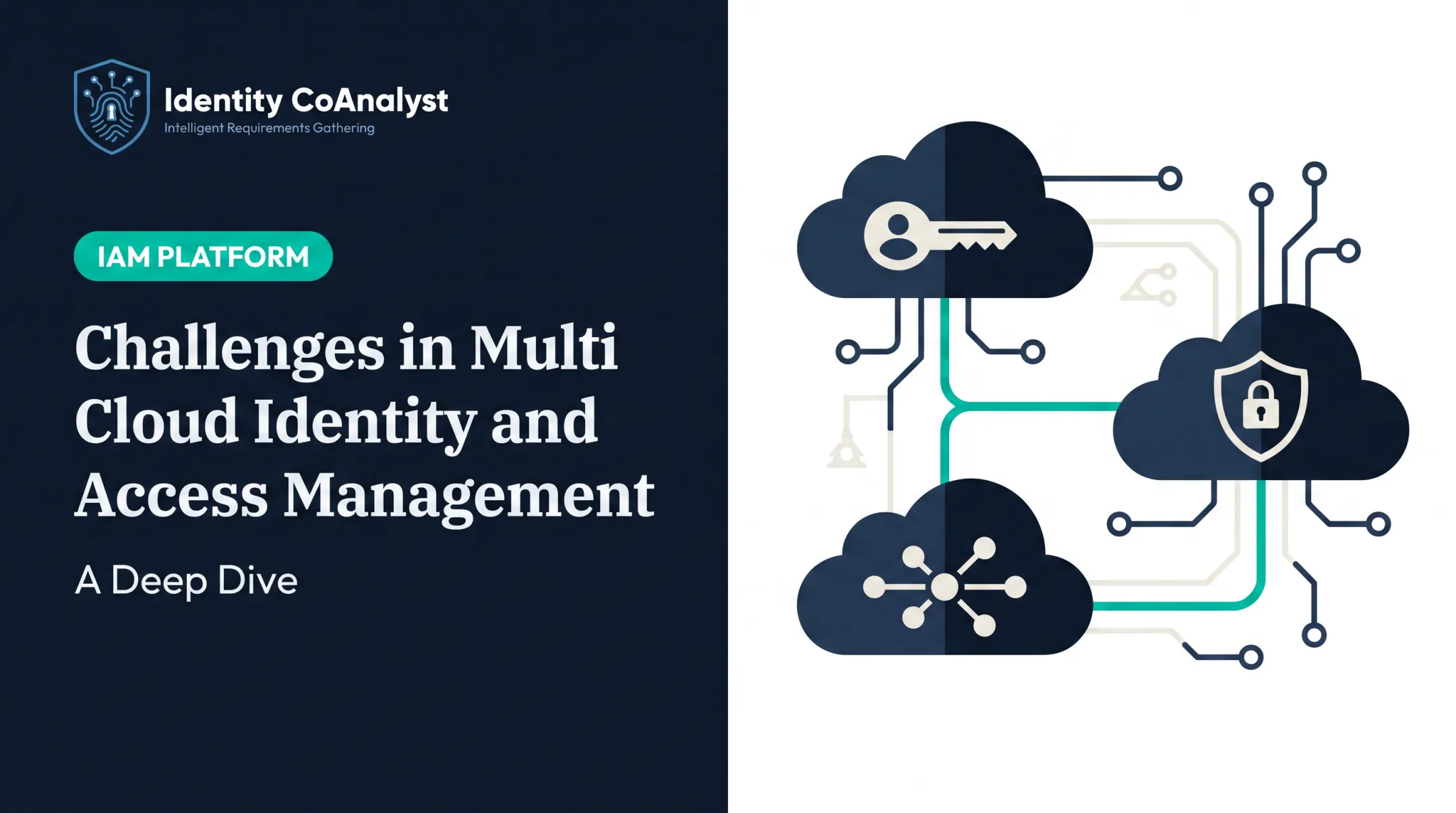
AWS, Microsoft Azure, and Google Cloud each handle identity differently:
- AWS uses IAM roles and identity-versus-resource policies
- Microsoft Entra ID relies on RBAC roles, groups, and administrative units
- Google Cloud attaches allow policies through an inherited organization-folder-project hierarchy

None of them speak the same policy language.
That fragmentation is common, not rare. The Cloud Security Alliance's 2024 survey of 950 IT and security professionals found 75% of organizations manage two or more identity providers, and 40% report inadequate visibility into user behavior across them.
A Federated Strategy Beats a Fragmented One
Rather than forcing every cloud into an identical model, most organizations do better with a federated or centralized approach:
- Preserve cloud-native authorization logic where it already works
- Layer shared enterprise controls on top: authentication standards, lifecycle triggers, and ownership rules
- Keep approval chains, logging, and review cadence consistent across providers
- Govern access the same way whether the resource lives in one cloud or three
Reconciliation Keeps the Picture Accurate
Identities and entitlements need mapping across providers to catch duplicate or orphaned accounts and normalize permissions that look different but grant the same access. Provider-specific context still matters. Flattening everything into one generic model loses the detail needed for accurate decisions.
Don't Forget Non-Human Identities
Service accounts, workload identities, API keys, and automation roles now often outnumber human accounts by a wide margin. Each one needs clear controls:
- An owner and a defined purpose
- A rotation schedule and a tight scope limit
- Active monitoring and a retirement plan
Continuous scanning tools that discover service accounts and feed them into certification campaigns catch what manual inventories miss. Unmanaged service accounts left unreviewed rarely get decommissioned at all.
Human and non-human identities still need shared enforcement. Centralized reporting, SIEM integration, and policy-as-code give teams repeatable controls and drift detection across every environment they run.
Common Gaps and How to Evaluate Maturity
Most governance programs don't fail from lack of effort. They fail from predictable, avoidable gaps.
Frequent failure points:
- Spreadsheet-based access reviews that nobody has time to keep current
- Incomplete application inventories with unknown ownership
- Manual offboarding that leaves accounts active for weeks
- Excessive standing privilege granted "just in case"
- Unmanaged service accounts nobody remembers creating
- Duplicated identities across systems and undocumented exceptions
The Maturity Progression
Programs move through recognizable stages:
- Ad hoc manual administration
- Documented but manual controls
- Automated lifecycle workflows
- Integrated certifications
- Risk-based, continuous policy enforcement

Each stage removes a layer of manual work and replaces it with automated, evidence-generating processes.
The Evaluation Checklist
Ask your organization these questions. If you can't answer all of them quickly, you have a gap:
- Who has access right now?
- What can they actually do with it?
- Why do they have it?
- Who approved it?
- When does it expire?
- Is it still being used?
- How fast can it be revoked?
Frequently Asked Questions
What does cloud governance mean?
Cloud governance covers the policies, responsibilities, processes, and controls used to manage cloud resources, security, compliance, cost, and risk. Identity governance is one important piece within that broader umbrella.
What is the difference between cloud identity governance and cloud IAM?
Cloud IAM handles authentication and authorization at runtime. Identity governance adds lifecycle oversight, access requests, approvals, certifications, policy management, ownership, and audit evidence on top of it.
What are the main components of a cloud identity governance framework?
They include governance policies, identity and entitlement data, lifecycle management, access controls, privileged access management, recurring certifications, monitoring, and accountable ownership.
Why are access reviews important in cloud identity governance?
Recurring reviews confirm whether access is still necessary, catch privilege creep and orphaned accounts, and create documented evidence that owners actively reassessed permissions.
Does cloud identity governance apply to non-human identities?
Yes. Service accounts, workload identities, API credentials, and automation roles all need ownership, defined purpose, least privilege, monitoring, and eventual retirement.
How can organizations govern identities across multiple cloud providers?
Adopt a common enterprise governance model: federated identity, normalized ownership and lifecycle rules, cloud-specific authorization controls, centralized visibility, and recurring cross-cloud reconciliation.