
Introduction
Enterprise applications, cloud platforms, directories, databases, healthcare systems, and government agencies rely on the same authorization model: role-based access control.
It also shapes internal business tools—whether an employee can view a record, approve a payment, or only look without making changes.
Many organizations still assign permissions one user at a time. That approach breaks down fast once headcount grows, contractors rotate through projects, and applications multiply. Tracking who has access to what becomes guesswork, and audits turn into fire drills.
The risk is real. Stolen credentials were involved in 31% of breaches analyzed in Verizon's 2025 Data Breach Investigations Report, more than double any other single attack vector.
This guide covers RBAC's core principles, how users and permissions connect through roles, the main models, practical examples, and where the model falls short.
Key Takeaways
- RBAC grants access through predefined roles instead of assigning every permission to each user directly
- Core principles include role assignment, role authorization, permission authorization, least privilege, and separation of duties
- Permissions are defined, grouped into roles, assigned to users, evaluated on each request, and reviewed over time
- Scale and auditability hold when roles stay lean; poor design drives role explosion and excess access
What Is Role-Based Access Control (RBAC)?
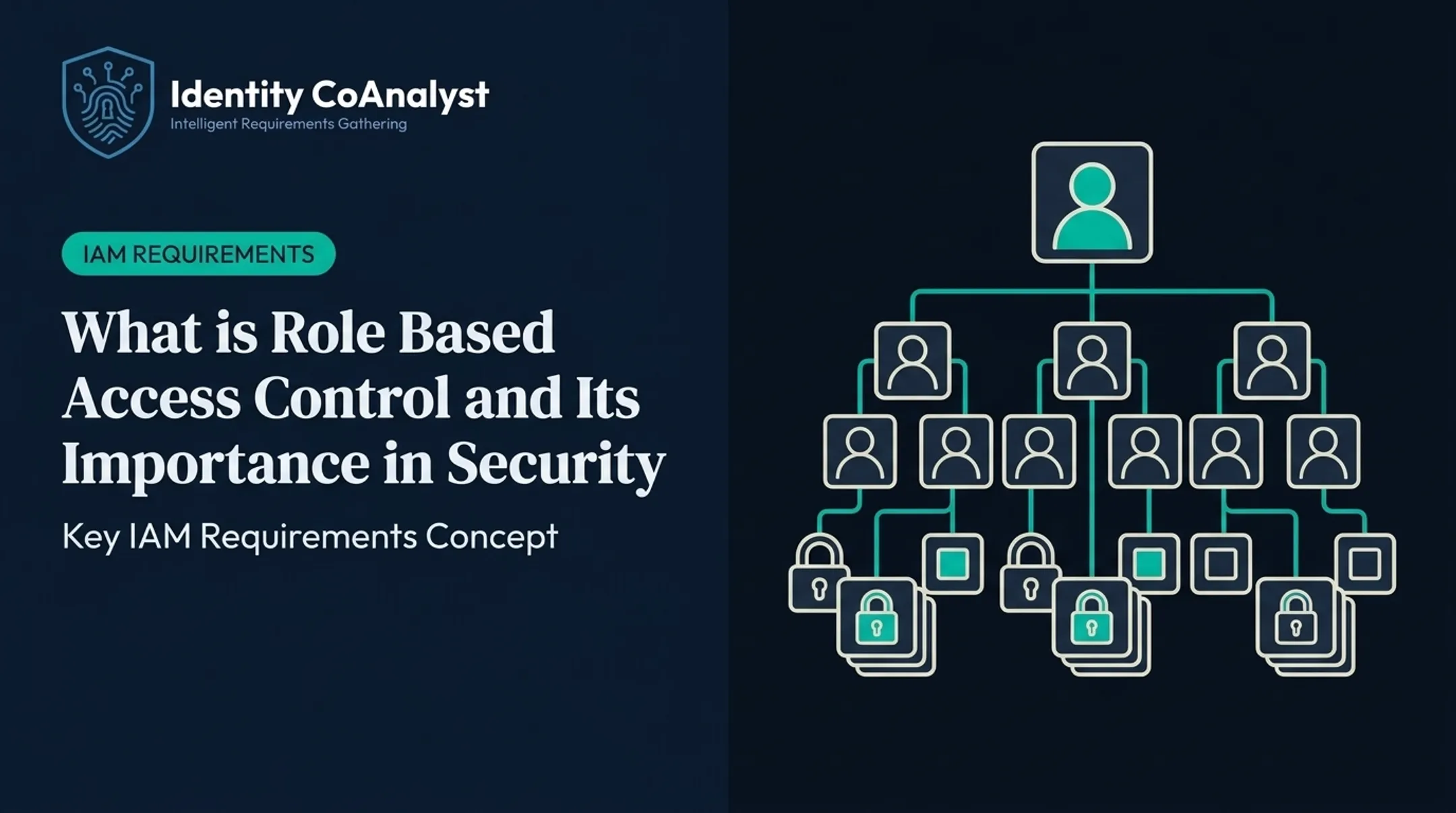
Role-based access control is an authorization model where users, applications, services, and other identities receive permissions through roles rather than direct grants. A role represents a business responsibility or access function, not a person.
Five core terms define the model:
- User - the person or non-human identity requesting access (an employee, contractor, or service account)
- Role - a named collection of permissions tied to a job function
- Permission - the specific right to perform an action, such as read or update
- Resource - the application, file, database, or system being protected
- Session - the active period during which a user's roles are in effect
Consider a hospital nurse role: it can view patient information and record vitals, but it cannot prescribe medication. That boundary is set once, at the role level, and applies to every nurse without anyone manually configuring individual permissions.
Authentication vs. Authorization
Authentication confirms who is requesting access - a login, a badge scan, a multi-factor prompt. RBAC picks up after that point. It governs what the authenticated identity is allowed to do once inside the system.
The Three Primary RBAC Rules
NIST's Role Based Access Control model, standardized as ANSI/INCITS 359, defines three rules:
- Role assignment - a user must have an assigned, active role before performing any transaction
- Role authorization - the user's active role must be one they're authorized to hold
- Permission authorization - a user can exercise a permission only if it belongs to one of their authorized roles

Two governance principles sit alongside these rules:
- Least privilege - users get only the access their job requires, nothing extra "just in case"
- Separation of duties - keeps conflicting activities apart, such as preventing the person who creates a payment from also approving it
RBAC vs. LDAP
LDAP is a directory protocol, defined in RFC 4510, used to store and retrieve identity and group data. RBAC is an authorization model that decides access. An LDAP group can support an RBAC implementation by holding role membership data, but it isn't RBAC itself.
How Does RBAC Work?
RBAC operates as a chain: business responsibilities become permissions, permissions get grouped into roles, and roles connect to identities. Every access request runs through that chain before it's approved or denied.
Define Permissions and Resources
Organizations start by inventorying the actions users can take - read, create, update, approve, execute, delete - and mapping those actions to applications, data, files, APIs, infrastructure, and business transactions.
Permissions should reflect real business operations, not arbitrary technical fragments. Defining a permission for every button and API call sounds thorough, but it usually backfires: finer permissions mean more role combinations, and role counts spiral upward fast.
Design Roles Around Responsibilities
Roles group related permissions around a job function or controlled purpose. Common examples:
- Accounts Payable Processor
- Nurse
- Database Administrator
- Auditor
- Application Developer
Organizations typically distinguish three role types:
- Business roles — tied to job function
- Application roles — specific to one system
- Technical roles — granular technical permissions
Many also use role hierarchies, where a senior role inherits everything a junior role has, plus additional access.
Solid role design documents each role clearly, including:
- Purpose and named owner
- Eligibility criteria and included permissions
- Approval requirements, expiration rules, and review frequency
Skip the documentation, and roles drift from their original intent without anyone noticing.
Assign Users and Identities to Roles
Users receive roles based on authoritative data: employment status, department, job function, location, project membership, or an approved access request. One person can hold multiple roles, but combined roles need evaluation for excessive access or conflicts.
This is where joiner, mover, leaver processes matter. Access gets provisioned when someone joins, adjusted when responsibilities change, and revoked when it is no longer justified. Temporary staff, contractors, and service accounts all need the same discipline.
Evaluate an Access Request
At runtime, the sequence looks like this:
- The identity authenticates
- A session is established
- The user requests an action
- The system checks active role assignments and role permissions
- The request is allowed or denied

RBAC doesn't replace authentication controls like MFA or SSO. Those establish confidence in who's asking before RBAC decides what they can do.
Picture a doctor, a nurse, an admissions clerk, and an auditor all interacting with the same patient record system. The doctor can prescribe. The nurse can record vitals but not prescribe. The clerk can update demographic fields but can't view clinical notes. The auditor can view and export logs but can't modify anything. Same system, four different outcomes, all driven by role.
Apply Constraints and Separation of Duties
Static separation of duties (SSD) prevents a user from being assigned two conflicting roles in the first place, such as Purchase Requestor and Purchase Approver. Dynamic separation of duties (DSD) allows a user to hold both roles but blocks activating them in the same session, enforcing something like a two-person rule at the point of action.
Role hierarchy cuts both ways. Inheritance reduces duplicate work, but if nobody reviews what's being inherited, access broadens without anyone catching it.
Controls that keep RBAC aligned with least privilege include:
- Approval workflows and access certifications
- Named role owners and audit logs
- Time limits and exception tracking
Review and Improve the Model
RBAC isn't a set-and-forget system. A recurring governance cycle should check role membership, role-to-permission mappings, unused access, excessive privileges, SoD conflicts, orphaned roles, and shifts in business structure.
Common failure modes include:
- Role explosion from overly granular permissions
- Overlapping roles that do nearly the same thing
- Generic shared accounts with no individual accountability
- Stale assignments left behind after a mover or leaver event
- Roles built around current technical access instead of actual job duties
Before any of this gets configured in a platform, someone has to gather the requirements: which roles exist, which permissions they need, and which conflicts matter.
That discovery phase is where Identity CoAnalyst fits. AI-guided, vendor-agnostic questionnaires help consulting teams and organizations capture business processes, access scenarios, and governance constraints before an IGA or IAM platform is configured. It supports discovery upstream of enforcement—it does not run RBAC itself.
Where Is RBAC Used?
RBAC threads through enterprise IAM and IGA programs. Common control points include:
- Workforce identity and application access
- Cloud resources, databases, and APIs
- Operating systems and privileged access workflows
Healthcare
Hospitals commonly separate doctor, nurse, admissions, laboratory, and billing roles to keep clinical, administrative, and sensitive-record permissions apart.
The HIPAA Security Rule, under 45 CFR 164.312, requires technical policies that limit electronic health information to users with granted access rights. It doesn't name RBAC, but role-based access maps cleanly onto those requirements.
Financial Services, Government, and Beyond
- Financial services: separates transaction preparation from approval, a core FFIEC expectation for reducing fraud risk
- Government: NIST SP 800-53 treats role-based schemes as a standard way to organize access and enforce least privilege
- Higher education: FERPA permits access only for staff with a legitimate educational interest in specific records
- Legal: firms use role-based permissions to restrict visibility into sensitive case files, per ABA guidance
- Manufacturing: separates corporate IT (ERP, email) from plant-floor systems (SCADA, MES, PLCs)

When RBAC Isn't Enough
RBAC works best when job responsibilities are stable and repeatable. When decisions also depend on time of day, device, location, or data sensitivity, pair RBAC with attribute-based access control (ABAC) or risk-based authentication to cover those factors.
Conclusion
RBAC turns business responsibilities into governed access by connecting identities to roles and roles to permissions. That structure is what makes audits tractable and access reviews possible at scale.
Speed isn't the hard part. Getting roles right is. Effective RBAC depends on:
- Accurate requirements
- Least-privilege design
- Separation-of-duties controls
- Lifecycle automation tied to joiner-mover-leaver events
- Continuous review
- Clear ownership
Skip any one of those, and role explosion or access creep follows.
Frequently Asked Questions
Which is better, RBAC or ABAC?
Neither wins universally. RBAC is simpler for stable, job-based access, while ABAC adds context like time, location, or data sensitivity for finer-grained decisions. Many enterprises run both together.
What are the differences between LDAP and RBAC?
LDAP is a directory protocol for storing and retrieving identity and group data. RBAC is an authorization model that decides what a user can do. LDAP groups often support role assignments but aren't RBAC itself.
What is role-based access control (RBAC)?
RBAC grants permissions through predefined roles assigned to users or other identities based on their responsibilities, rather than assigning every permission individually.
What are the three primary rules for RBAC?
Three primary rules govern RBAC: role assignment, role authorization, and permission authorization. Users must hold an active, authorized role, and permissions attach only through those roles.
What are some RBAC examples?
A hospital nurse role views records and records vitals but can't prescribe. An accounts payable processor creates payments but can't approve them. A university grants student, faculty, or staff roles with different system access.
What are the four types of access control?
Discretionary (DAC), mandatory (MAC), role-based (RBAC), and attribute-based (ABAC) are the four commonly discussed models. Organizations also use ACLs, rule-based, and relationship-based approaches, often blending several together.