
Introduction
A new hire's first week often includes a familiar frustration: waiting on badge access, email, or a CRM login while a manager chases down IT tickets. Meanwhile, a contractor who left three months ago might still have an active VPN account nobody remembered to disable.
Both problems trace back to the same root cause: how organizations create, adjust, and remove access to systems.
User provisioning is the process of creating, updating, assigning, and revoking digital identities and access across systems and applications. It sounds simple, but doing it well touches HR systems, directories, applications, and every approval step in between.
The stakes are real. According to a 2022 survey by the Identity Defined Security Alliance, 84% of organizations experienced an identity-related breach in the prior year.
This article covers the identity lifecycle, provisioning methods, the technology stack behind automation, governance requirements, and how provisioning differs from related IAM functions like single sign-on and authentication.
Key Takeaways
- Provisioning spans the full joiner-mover-leaver lifecycle, beyond day-one onboarding.
- It ties identity data, access policies, approvals, target apps, and audit records together.
- Automation handles routine access changes; high-risk or exception paths still need review.
- SCIM syncs accounts and attributes; SSO only helps after the account already exists.
What Is User Provisioning and Why Does It Matter?
User provisioning is the operational engine behind identity and access management. It covers account creation, attribute updates, group membership changes, entitlement assignments, role assignments, and access removal: every action that turns a policy decision into a working (or disabled) account.
NIST's guidance on identity management and account provisioning describes it as gathering identity and credential data, applying provisioning policies, assigning groups and privileges, and syncing that data through a UI, CLI, or API. That's the mechanical side. Deciding who should get what is a separate, equally important question.
Provisioning vs. Authentication, Authorization, and SSO
These terms get used interchangeably, but they solve different problems:
- Authentication verifies who a user is, through a password, MFA prompt, or biometric check.
- Authorization determines what an authenticated user is allowed to do.
- Provisioning creates and maintains the accounts and permissions that make both of those decisions possible.
- Single sign-on (SSO) offers a convenient sign-in experience, but it doesn't create accounts, assign entitlements, or remove access when someone leaves.

An authoritative source, usually an HR system or directory, triggers identity changes that flow downstream. When an HR system marks someone as terminated, that event needs to reach Active Directory, Salesforce, and every other connected application, not just one login screen.
Why Weak Provisioning Creates Real Risk
Provisioning operationalizes the access-control policies most security teams already have written down somewhere: least privilege, role-based access, separation of duties, time-bound access, and approval workflows. Without a working provisioning process, those policies stay theoretical.
Weak provisioning shows up as:
- Delayed onboarding that stalls new hires and contractors
- Excessive permissions granted "just in case"
- Inconsistent access across applications for people in the same role
- Orphaned accounts left behind after someone leaves
- Privilege creep from access that never gets removed after a role change
- Incomplete audit trails that fail compliance reviews
Deprovisioning is the mirror image of this process: disabling accounts, removing entitlements, and terminating sessions or credentials when employment, role, contract, or business need changes.
A quick example: A new sales rep gets baseline access on day one: email, CRM, and expense system. Three weeks later, she requests access to a reporting tool for a project, and her manager approves it.
Six months in, she transfers to marketing, losing her old sales entitlements and picking up new ones. When she eventually leaves the company, every accumulated permission needs to disappear, not just her primary login.
How Does User Provisioning Work Across the Identity Lifecycle?
Every provisioning action starts with an event and ends with an account change. The path between those two points involves validation, decisions, and record-keeping.
From Identity Event to Account Change
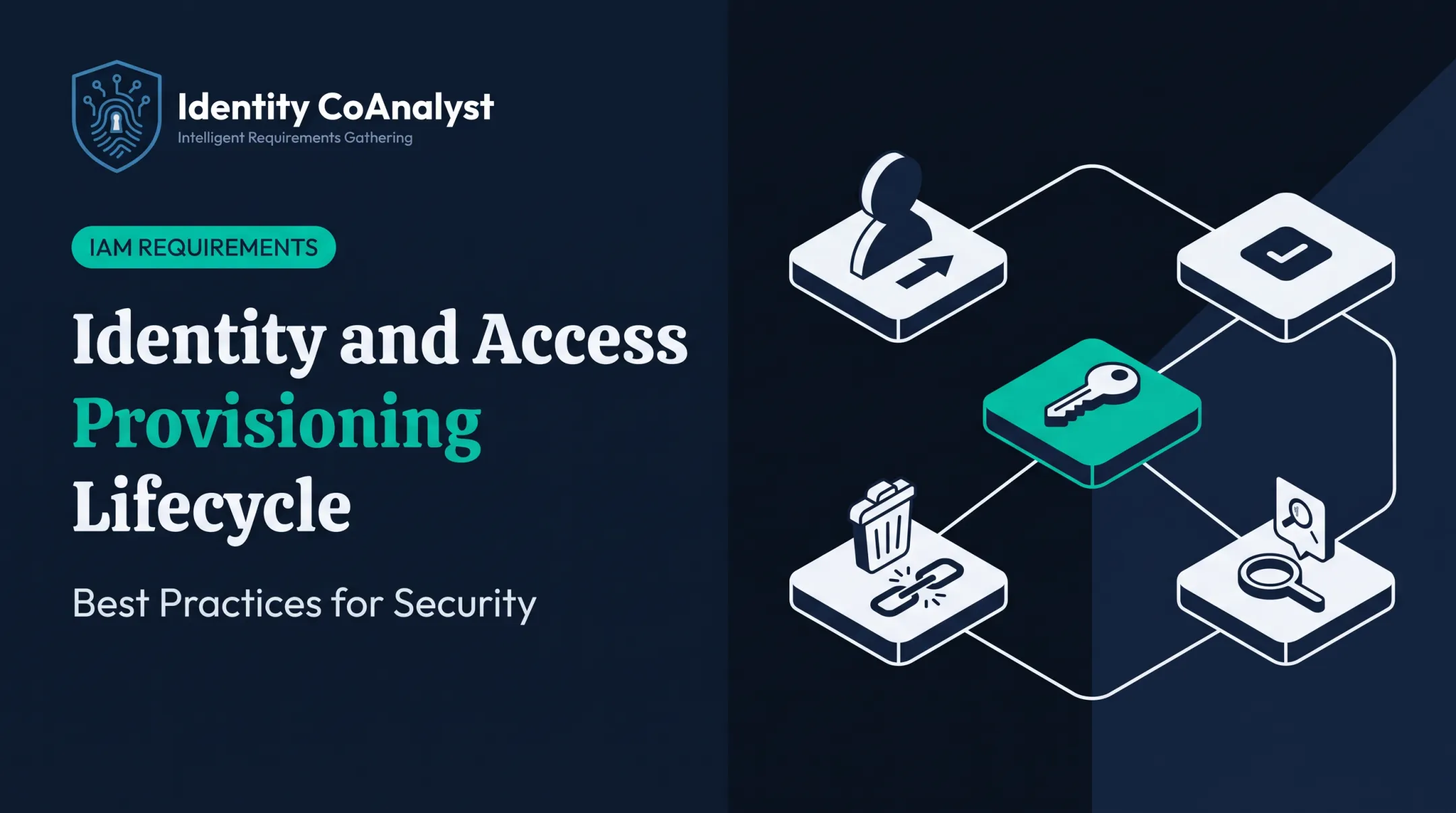
A typical workflow runs through five stages:
- Identify the source event — a hire, transfer, promotion, contractor start date, leave of absence, or termination.
- Validate identity attributes and employment status, then map them to roles, groups, and birthright access.
- Determine the approval path — automatic, manager-approved, application-owner-approved, or subject to segregation-of-duties checks.
- Create or update accounts in directories and target applications via connectors, APIs, or standards such as SCIM.
- Log the request, decision, and fulfillment result for monitoring and audit.

Timing matters. Many IGA implementations import a new hire's identity from HR a few days before the start date, but hold provisioning until employment status turns active.
At that trigger, the joiner workflow creates the directory account, provisions email, and assigns baseline access plus a department role—often within hours.
The Joiner-Mover-Leaver Model in Practice
Those five stages play out differently for joiners, movers, and leavers. Movers are consistently the hardest. A promotion or department transfer means new access is required while permissions tied to the previous role must go away.
Done well, a department change immediately revokes the old role, assigns the new one, and flags remaining access for recertification by the new manager within about 30 days.
Leavers carry the highest stakes. IDSA's 2021 research found that only 34% of organizations revoked access on the actual day of departure, and half took three days or longer. A tighter model closes that gap:
- Revoke access and disable accounts on the termination date
- Forward email to the manager for a defined period
- Schedule permanent account deletion around 90 days out
Handling Exceptions and Ongoing Review
Not every request follows the same path. Low- and medium-risk access often needs just manager approval, with a short SLA before escalation. High-risk access—financial reporting, PHI, admin rights—typically needs sequential approval from a manager, application owner, and security team, with no auto-approval fallback.
Exceptions happen. An unavailable connector, conflicting attributes, or a duplicate account can stall fulfillment mid-process, so recovery procedures need to be defined in advance rather than improvised on the fly.
Before automating any of this, organizations need blunt answers to a few questions:
- Which system is authoritative for identity data?
- Which applications are actually in scope?
- Who approves what, and how quickly?
- What happens when source data conflicts?
Types, Standards, and Technologies Used in User Provisioning
Provisioning approaches range from fully manual to fully automated, and most organizations run a mix depending on the application and the risk involved.
| Approach | How it works | Best fit |
|---|---|---|
| Manual | Administrators follow documented procedures | Rare or exceptional access |
| Automated | Rules and connectors trigger changes from lifecycle events | High-volume, repeatable access |
| Role-based | Standard access tied to job function | Common roles like "Sales Rep - US" |
| Attribute-based | Access driven by department, location, employment type, or risk | Conditional or nuanced access |
| Workflow-based | Requests route through defined approval steps | Anything needing sign-off |
| Self-service | Users request limited access under policy controls | Low-risk, well-defined requests |
The Technology Stack Behind Provisioning
Most implementations share the same core components:
- Authoritative sources (HR systems, directories) supply identity and lifecycle data
- Directories and identity providers store identities, groups, and authentication data
- IAM platforms manage identities, policies, and provisioning workflows
- IGA platforms add access certifications, policy enforcement, and compliance reporting
- Connectors and APIs connect everything to cloud, on-premises, and SaaS applications
SCIM and SSO Solve Different Problems
SCIM, or System for Cross-domain Identity Management, is a standardized way for systems to create, update, deactivate, and synchronize user and group data between a provisioning service and a target application. The SCIM protocol specification explicitly puts authentication and authorization methods out of scope. SCIM's job is account lifecycle and identity data, full stop.
SSO handles the sign-in experience once an account already exists. Most organizations run both together: SCIM keeps accounts current across applications, while SSO, via protocols like SAML or OpenID Connect, lets users authenticate into them. Neither one replaces the other.

Choosing Provisioning Software
Centralized automation speeds up routine access changes, but sensitive, temporary, or unusual requests still need a person in the loop. When you evaluate provisioning software, weigh:
- Integration coverage across your actual application portfolio
- Lifecycle workflow support for joiners, movers, and leavers
- Role and attribute modeling flexibility
- Approval controls and audit logging
- Deprovisioning reliability, not just provisioning speed
- Scalability and support for hybrid environments
Before production, test representative scenarios: a new joiner, a department transfer, a contractor, a duplicate identity, a failed connector, and an over-privileged account. If those edge cases clear cleanly, routine joiners, movers, and leavers almost always will too.
Best Practices and Implementation Considerations
Provisioning policy documents should define the rules of the road before anyone touches platform configuration. Cover at least:
- Access ownership and approval responsibilities
- Role criteria and lifecycle triggers
- Exception handling and deprovisioning expectations
- Evidence requirements for audits
A few practices consistently separate durable programs from fragile ones:
- Base roles on actual job responsibilities, not assumptions, and review them regularly to catch privilege creep early.
- Apply least privilege and time-bound access for sensitive, temporary, contractor, and privileged accounts, with automatic expiration on project access.
- Fix data quality issues first. Inconsistent names, employee IDs, or department codes cause more duplicate accounts and misrouted access than any technology gap does.
- Prioritize critical applications and high-risk events before automating everything at once. Track fulfillment accuracy, approval delays, and deprovisioning completion.
Start With Discovery, Then Keep Workflows Current
Most identity projects stumble when nobody agrees on the authoritative source, the roles, or the approval chain before implementation starts. That agreement has to happen across HR, security, application owners, and IT, and it has to happen early.
Identity CoAnalyst closes that gap. The vendor-agnostic platform guides discovery through structured, AI-assisted stakeholder conversations and generates implementation-ready requirements documentation for IGA, IAM, or PAM initiatives, cutting the weeks of scheduling and spreadsheet work discovery usually takes.

Once requirements are set and a workflow is live, treat it as a living system rather than a finished project. Audit trails, access certifications, and exception reports should feed periodic policy updates. A workflow that was correct at launch won't necessarily stay correct as roles, applications, and staff change over time.
Frequently Asked Questions
What is user provisioning?
User provisioning is the process of creating, maintaining, modifying, and removing user accounts and access rights throughout the identity lifecycle, from hire to role change to departure.
What is the purpose of user provisioning?
It gives users appropriate access when they need it, removes outdated access promptly, reduces manual errors, supports least privilege, and improves visibility and auditability across systems.
How does user provisioning work?
A lifecycle event from an authoritative source, like an HR system, triggers identity validation and an access decision. The system then updates accounts across target applications, routes approvals where required, and logs the result for audit purposes.
What is user provisioning software?
It's software that automates identity lifecycle tasks, including account creation, updates, deprovisioning, application integrations, reporting, and governance controls, instead of relying on manual administrator processes.
How can I automate user provisioning?
Start by integrating your HR system or directory as the authoritative source, then design roles and access policies. Layer in IAM or IGA workflows with connectors or SCIM, test thoroughly, and automate deprovisioning alongside provisioning.
What is the difference between SCIM provisioning and SSO?
SCIM synchronizes accounts and identity attributes across systems. SSO handles authentication and sign-in once an account exists. Most organizations use both together, since one doesn't replace the other.