
Machines now outnumber humans by 50 to 1 in many cloud environments, according to IDSA's 2025 research on non-human identity risk. That's a lot of accounts to track, especially when access sprawls across cloud, on-premises, and legacy systems that were never designed to talk to each other.
Identity Governance and Administration, or IGA, exists to solve exactly this problem. This article breaks down what IGA actually means, its governance and administration halves, the core capabilities that make it work, how it operates across the identity lifecycle, and what to clarify before committing to a platform.
Key Takeaways
- IGA pairs governance (decisions, policy, oversight) with administration (execution, provisioning) into one connected system
- Core components span lifecycle management, access governance, entitlement and role management, requests, and certifications
- The joiner-mover-leaver lifecycle drives most day-to-day IGA activity
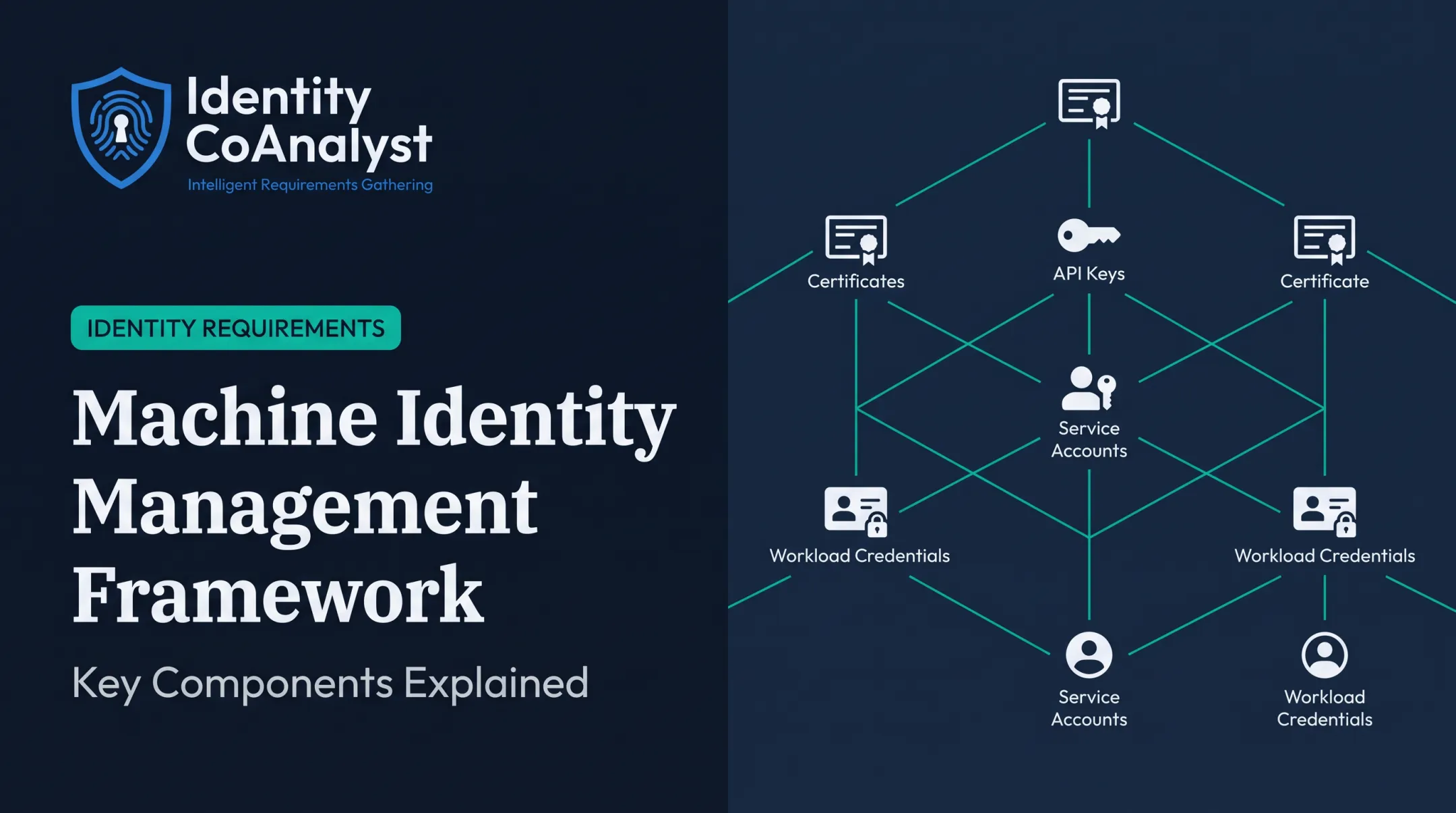
- Non-human identities and service accounts need the same governance rigor as employees
- Clear requirements gathering before implementation prevents scope creep and rework later
What Is Identity Governance and Administration and Why Does It Matter?
Identity Governance and Administration is the combination of policies, processes, controls, and technologies organizations use to manage identities and govern their access to systems, applications, data, and other resources.
Gartner describes IGA tools as solutions that aggregate and correlate disparate identity and access-rights data to manage the identity lifecycle and govern access across both on-premises and cloud environments.
That definition sounds tidy. The real question IGA answers is messier: does this specific identity have appropriate access, for a legitimate business reason, right now? That's different from "can this person log in?" Authentication confirms someone is who they claim to be. IGA asks whether they should still have the access they're using once they're in the door.
The outcomes IGA supports, and what they depend on
Done well, IGA supports:
- Least-privilege access across the identity population
- Reduced access sprawl and fewer orphaned entitlements
- Faster fulfillment of legitimate access requests
- Clearer accountability for who approved what, and why
- Stronger audit readiness with documented evidence
None of that happens automatically. These outcomes depend on accurate identity data, well-designed policies, and actual adoption by managers, application owners, and end users. A platform loaded with stale HR data or undefined role ownership produces the same access sprawl it was meant to fix, just with better reporting on the problem.
Who IGA actually governs
IGA commonly covers more than full-time employees. Depending on scope and platform capabilities, it typically extends to:
- Contractors and vendors
- Partners with system access
- Service accounts and bot/automation accounts
- Applications carrying their own credentials
This matters because non-human identities keep multiplying. Thousands of service accounts commonly end up with unknown owners that never get decommissioned, quietly expanding the attack surface long after anyone remembers why the account exists.

What Does IGA Comprise? The Core Components
IGA isn't a single feature. It's an interconnected model where each piece feeds the others: identity lifecycle management, access governance and entitlement management, access requests and approvals, and access certification.
Identity lifecycle management
This covers the full arc of an identity's existence: creation, attribute changes, access assignment, modification, suspension, and deprovisioning. That arc is the joiner-mover-leaver (JML) lifecycle, and it triggers nearly everything else in an IGA program.
Access governance and entitlement management
Access governance is the oversight layer. It defines who should receive access, under what conditions, for how long, and with whose approval. Entitlement and role management sits underneath it, covering:
- Permissions, groups, and roles built around RBAC
- Attribute-based or context-based controls (ABAC) for access that doesn't fit a defined role
- Role mining, which uses pattern analysis on existing access to surface common permission combinations
- Role engineering, a top-down approach that designs roles around business structure
Get role design wrong and two problems show up fast. Role explosion multiplies narrow roles until nobody can manage them. Role drift piles on permissions that get added but rarely removed. Both need periodic role hygiene.
Access requests, approvals, and policy controls
This is where day-to-day access changes actually happen:
- Manager or resource-owner approval routing
- Least-privilege defaults with time-bound access for temporary needs
- Exception handling for access outside standard policy
- Segregation-of-duties (SoD) checks that block or flag conflicting entitlement combinations
Approval routing scales with risk. Standard requests often go to a manager alone on a short turnaround. High-risk or financial-system access usually needs sequential sign-off from a manager, application owner, and compliance stakeholder—with no auto-approval path.
Access certification, audit trails, and analytics
This is the evidence layer. Certification (also called attestation) is a scheduled review of user access, role membership, and privileged or orphaned accounts.
Typical reviewers include:
- Managers attesting to direct reports' access
- Application owners confirming business justification
- Compliance officers validating policy adherence
Analytics closes the loop. It tracks approval times, SoD violations, and provisioning success rates, then feeds that data back into policy and role decisions.
Governance vs. Administration: How the Two Parts Work Together
The name "Identity Governance and Administration" describes two distinct functions that only work when paired.
Identity governance is the decision, oversight, and accountability function. It covers policies, risk rules, role definitions, review standards, compliance requirements, entitlement ownership, and exception management. Governance answers "should this access exist?"
Identity administration is the execution function. It covers creating and updating accounts, assigning or removing entitlements, fulfilling approved requests, synchronizing identity data, and handling self-service operations like password resets. Administration answers "make it happen, and record what happened."
A practical example
Consider a marketing coordinator requesting access to a new analytics tool:
- Governance determines whether the request is appropriate: is the tool relevant to her role, does it conflict with any SoD policy, and who needs to approve it?
- Administration executes the decision: routes the request to her manager, provisions the account once approved, and logs the fulfillment.

Governance without administration is a policy binder nobody enforces. Administration without governance is fast provisioning with no accountability for what's being provisioned.
The feedback loop
Administrative events—account creation, entitlement changes, and deprovisioning—generate the data that access reviews rely on. Governance decisions, in turn, reshape workflows, roles, and provisioning rules based on what those reviews find.
A quarterly certification flagging a role with excessive, rarely-used permissions is a governance decision. Rebuilding that role and repointing provisioning to it is administration acting on that decision.
Why the split matters organizationally
Separating governance from administration helps assign responsibility across security, IT, HR, application owners, managers, and compliance stakeholders:
- Application owners typically own entitlement definitions for their systems
- Managers own attestation for their direct reports
Without this split, IGA tends to get treated as an IT-only project. The tooling gets built, but nobody outside IT owns the decisions it's supposed to enforce—a common reason implementations stall.
How IGA Works Across the Identity Lifecycle
Most IGA activity traces back to a single authoritative source, usually an HR system, supplemented by contractor, vendor, or directory data. That source supplies attributes such as job title, department, employment status, and manager that drive nearly every access decision downstream.
Microsoft's Entra ID Governance model frames this as three phases: Joiner, Mover, and Leaver, each triggered by a change in someone's relationship to the organization.
Joiner: onboarding and provisioning
When a new hire's record goes active in the HR system, an IGA platform:
- Validates the incoming identity data
- Creates the digital identity and core accounts (directory, email)
- Assigns birthright access tied to the role or department
- Routes additional, non-standard requests for approval
- Records the business justification and approval trail
A marketing manager hire, for example, might get directory, email, and intranet access provisioned within hours, while role-specific tools like a CRM route through manager approval first.
Mover: changes mid-employment
Movers are trickier than joiners because they involve removing access, not just granting it. When a department, job, location, or manager changes, the platform needs to:
- Detect the change from the authoritative source
- Revoke access tied to the old role
- Assign access tied to the new one
- Flag conflicts or exceptions for manual review
Many organizations build in a grace period, often around 30 days, for handoff of responsibilities before old access is fully cut off.
Leaver: offboarding
A termination event should trigger fast, near-complete access removal:
- Disabling accounts
- Revoking VPN and remote access
- Addressing MFA devices where supported
- Preserving audit evidence of what was removed and when
Some organizations allow a short grace period, roughly a week, for email forwarding before full deprovisioning and license reclamation.

Beyond lifecycle events: ongoing controls
Lifecycle events aren't the only source of change. Ongoing controls include:
- Self-service access requests
- Periodic certifications
- Risk-based reviews
- Orphan-account detection for unused entitlements
None of this holds up without reliable source data, clearly assigned application ownership, adequate connector coverage, and exception handling tested against legacy systems—not just modern SaaS apps.
IGA Capabilities and Integrations
An IGA platform's day-to-day value comes from a defined set of capabilities working together:
- Self-service access requests
- Approval workflows
- Automated provisioning and deprovisioning
- Password administration
- Access certifications
- Policy enforcement
- Audit reporting
Where IGA connects
IGA rarely operates in isolation. It typically integrates with:
- HR systems as the authoritative source
- Directories like Active Directory or Entra ID
- SaaS applications, ERP systems, and other business platforms
- IT service management tools for manual fulfillment of disconnected apps
- PAM solutions and security monitoring tools
IGA vs. adjacent IAM capabilities
IGA is one part of the broader identity and access management discipline. Authentication, MFA, SSO, PAM, CIEM, and ITDR all integrate with or consume IGA data, but each addresses a different need:
- Authentication/MFA/SSO confirms identity at login
- PAM controls and monitors privileged sessions
- CIEM manages cloud entitlement risk
- ITDR detects identity-based attacks
IGA governs the underlying access decisions those systems enforce.
A cross-system example
A department transfer updates an HR record and triggers an IGA workflow. That workflow updates directory group membership, starts provisioning for new application access, routes an approval to the new manager, and logs an audit record—all from one source event.
Preparing for an IGA Initiative
Before selecting or configuring a platform, document what you already have:
- Current identity population and authoritative sources
- Applications, directories, and entitlements in scope
- Existing roles, approval owners, and lifecycle events
- Compliance obligations and known manual processes
Questions stakeholders need to answer
A requirements phase should resolve:
- Which identities are in scope, human and non-human?
- Which systems are most critical to govern first?
- What access is birthright versus request-based?
- Who owns each entitlement, and what requires approval?
- How often do reviews need to happen?
- What evidence will auditors actually need?
A single contractor-access requirement can touch the HR system of record, three applications, an approval chain, and a regulatory control all at once. Skipping any of these questions tends to surface as rework mid-implementation, not before it.
Start narrow, then expand
A phased approach beats a full rollout. Start with a contained pilot:
- Prioritize high-risk identities and applications first
- Validate data quality and integrations before scaling
- Define measurable pilot outcomes up front
- Expand only after pilot findings are addressed
Even a narrow pilot still needs clear requirements. Gathering that detail manually—through workshops and spreadsheets—commonly takes 8 to 16 weeks.
Identity CoAnalyst closes that gap. It is a vendor-agnostic discovery platform that uses guided, conversational questionnaires across IGA, IAM, and PAM to help consulting teams and organizations capture requirements before platform evaluation begins.

It is a discovery tool, not a governance or provisioning system. It sits upstream of whichever IGA platform you eventually choose.
Frequently Asked Questions
What is Identity Governance and Administration (IGA)?
IGA combines policies, processes, and technology to manage identity lifecycles and govern access to systems, applications, and data. It covers provisioning, access reviews, policy enforcement, and audit evidence that access is appropriate.
What is IAM, and how does it differ from Identity Governance and Administration (IGA)?
IAM is the broader discipline covering authentication, access management, and governance so the right people and things get the right access. IGA is the subset focused on lifecycle oversight, access decisions, and compliance evidence.
What is the difference between governance and administration in Identity Governance and Administration (IGA)?
Governance sets policy, risk rules, and approval requirements, and it reviews whether access is appropriate. Administration executes those decisions: creating accounts, assigning entitlements, and provisioning or deprovisioning access on connected systems.
What are the core pillars of IAM?
Commonly cited pillars include identity lifecycle management, authentication, authorization or access management, governance, and auditing. Exact terminology varies depending on the framework or vendor you're referencing.
What are common examples of IAM and IGA systems?
IGA platforms include SailPoint, Saviynt, Omada, and Oracle Identity Governance. Adjacent IAM tools include identity providers, directories such as Active Directory or Entra ID, SSO and MFA, PAM solutions, and ITSM platforms for fulfillment.