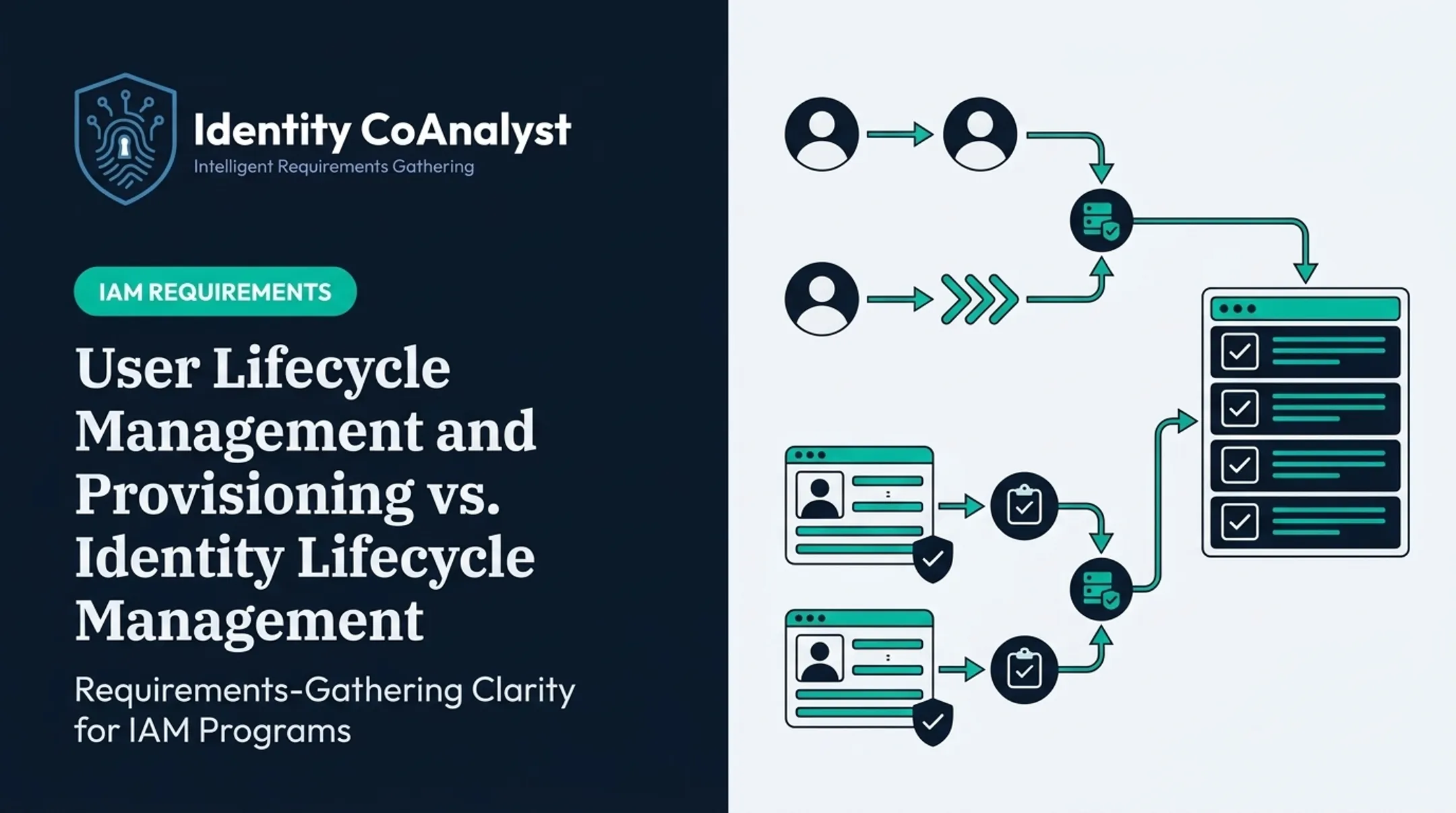

Provisioning refers to the process of creating, managing, and adjusting user access rights across systems as employees join, move within, or leave an organization. It's a core function of identity and access management (IAM), and it's also where many programs quietly go wrong.
This post covers the most common provisioning mistakes, why they keep happening, and practical fixes your team can implement now.
Key Takeaways
- Most provisioning errors trace back to manual processes and unclear role definitions
- Over-provisioning and delayed deprovisioning carry the highest breach risk
- Automated workflows plus upfront requirements gathering stop most failures early
- Regular access audits catch privilege creep before it becomes a liability
Why Provisioning Mistakes Happen
Most provisioning failures trace back to three root causes:
- Rushed onboarding timelines that force last-minute access requests
- Undefined role standards with no documented access baselines
- Poor coordination between HR, IT, and business stakeholders
When a new hire starts Monday and IT gets the request Friday afternoon, corners get cut.
Manual, spreadsheet-driven processes make this worse at scale. Every row is a chance for a typo, a missed field, or an outdated permission template. A 2023 Ponemon Institute survey of nearly 600 U.S. IT and security practitioners found that it takes an average of 7 hours to provision access for a single user when done manually.
Provisioning still commonly happens through tickets and email, with administrators logging into applications one by one to grant access. That's not a scalable model for any growing organization.
Incomplete requirements gathering before implementation is another cause many teams overlook. Without a documented definition of what a "sales manager" needs access to, every provisioning request becomes a guessing game—and undefined role standards stay undefined.
Common Mistakes in Provisioning User Accounts (and How to Fix Them)
Mistake 1: Over-Provisioning Access ("Just in Case")
Granting more access than a role requires feels efficient in the moment. It isn't. Every unused permission is an expanded attack surface waiting to be exploited.
Microsoft's 2023 State of Cloud Permissions Risks report found that less than 5% of permissions granted to workload identities are actually used, and 80% of workload identities sit inactive at any given time, a figure that's doubled since 2021.

The fix: Implement role-based access control (RBAC) tied to clearly defined job functions. Grant only what a role needs to function, not what might be convenient someday.
Mistake 2: Inconsistent or Undefined Roles Across Systems
When each application owner defines "manager access" differently, you end up with duplicate, conflicting, or mismatched permissions scattered across your environment. One system's "admin" role might be another's "read-only."
The fix: Standardize role templates and map access requirements before provisioning begins. This means:
- Documenting what each role needs in each system, not just in general terms
- Reviewing role definitions across HR, IT, and application owners together
- Retiring ad hoc roles created for one-off exceptions
Mistake 3: Relying on Manual, Spreadsheet-Driven Processes
Manual provisioning causes delays, introduces errors, and leaves changes untraceable, especially once you're managing hundreds of users across dozens of systems. Nobody can audit a change history that lives in someone's inbox.
The fix: Adopt automated provisioning tools integrated with HR systems and identity platforms. When a new hire is entered into the HRIS, access should flow automatically based on role, not wait for a manual ticket to work its way through the queue.
Mistake 4: Delayed or Incomplete Deprovisioning
Dormant accounts from offboarded employees or role changes are one of the top vectors for breaches.
The 2021 Colonial Pipeline ransomware attack is the clearest example on record: attackers gained entry through a compromised password on an inactive VPN account that lacked multi-factor authentication. The company ended up paying millions in ransom.
This pattern isn’t rare. Verizon's DBIR data, cited in that same CSO Online analysis, shows that over 80% of web application breaches involve stolen credentials, and old, unmonitored accounts are prime targets for credential reuse.

The fix: Automate deprovisioning triggers tied to HR status changes. The moment someone's employment status changes in the HRIS, their access should start winding down, not sit open for weeks.
Mistake 5: Skipping Requirements Gathering Before Implementation
Jumping straight into configuration without documenting actual business and access requirements leads to missed edge cases, rework, and rushed fixes down the line. Identity consulting firms and enterprises often lose 6 to 12 weeks here on stakeholder interviews, meetings, and spreadsheet reconciliation, according to internal delivery data from provisioning-focused consulting engagements.
That timeline usually plays out the same way. Consultants schedule interviews, stakeholders struggle with unfamiliar IAM terminology, and answers come back incomplete. Someone then chases clarifications before compiling a spreadsheet that still has gaps.
The fix: Replace interview-and-spreadsheet discovery with structured, AI-guided requirements gathering before configuration starts. Identity CoAnalyst does this with plain-language conversational questionnaires that explain unfamiliar terms, adapt follow-ups to what each stakeholder knows, flag contradictory answers, and generate implementation-ready documentation automatically. Engagements that used to take 12+ weeks can produce a baseline in under 10 days.

Mistake 6: Lack of Ongoing Audits and Access Reviews
Provisioning isn't "set and forget." Roles evolve, employees change departments, and old permissions rarely get removed on their own. This gradual accumulation is known as privilege creep, and it silently undermines least-privilege policies over time.
NIST SP 800-53's AC-2 control requires organizations to review accounts at an organization-defined frequency and disable accounts that are inactive or no longer tied to an active user. ISACA recommends scheduling access reviews quarterly or annually to maintain continuous control.
The fix: Schedule periodic access certifications and use automated anomaly detection to flag unusual permission grants before they become audit findings.
Best Practices to Prevent Provisioning Mistakes
Preventing provisioning mistakes comes down to written policy, consistent least-privilege controls, and automation tied to HR events.
- Document request, approval, and audit workflows end to end in one provisioning policy
- Enforce least privilege and RBAC consistently across every connected system
- Automate joiner-mover-leaver flows so access changes follow HR events without manual tickets
- Schedule regular access audits and keep compliance evidence ready for regulatory review

Getting Requirements Right from the Start
Most downstream provisioning errors trace back to one upstream failure: incomplete or rushed requirements gathering before an IGA, IAM, or PAM implementation ever begins. Fix that phase, and most of the mistakes above become far less likely.
Platforms like Identity CoAnalyst provide practitioner-built, vendor-agnostic questionnaires spanning 500+ questions across 11 identity domains. A dedicated Access Requests module covers:
- Entitlements and access scopes
- Approval chains
- Provisioning workflows
The output translates business-language stakeholder answers into technical requirements that consulting firms and enterprises can hand directly to implementation teams—whether they're deploying SailPoint, Saviynt, Okta, CyberArk, Omada, or another platform.
If you're evaluating or refreshing your provisioning process, prioritize discovery before you choose tools or start configuring systems. The requirements you skip now are the mistakes you'll be fixing in eighteen months.
Frequently Asked Questions
What does "provisioning of user accounts" mean?
Provisioning is the process of creating, managing, and adjusting user access rights across systems as part of identity and access management. It covers everything from initial account creation to ongoing entitlement updates.
What are the four types of user accounts?
Common groupings include standard/end-user accounts, administrative/privileged accounts, service or system accounts, and guest/temporary accounts. NIST's broader taxonomy also includes shared, group, and emergency account types.
What is the difference between provisioning and deprovisioning?
Provisioning grants access when someone joins the organization or changes roles. Deprovisioning revokes that access when someone leaves or no longer needs it. Delays here create real security exposure.
How often should organizations audit user access?
Industry guidance recommends quarterly or semi-annual reviews, plus event-triggered reviews whenever someone changes roles or leaves. NIST leaves the exact frequency to each organization's own risk-based policy.
Can small organizations automate provisioning without enterprise IAM tools?
Yes. SCIM-based integrations (an open protocol defined in IETF RFC 7644) let smaller teams connect their HR system or directory to SaaS apps for automated provisioning and deprovisioning without a full IGA platform.
Why is requirements gathering important before provisioning implementation?
Clear requirements prevent misconfigured roles, missed access needs, and costly rework after go-live. Skipping this phase is one of the most common and expensive provisioning mistakes organizations make.