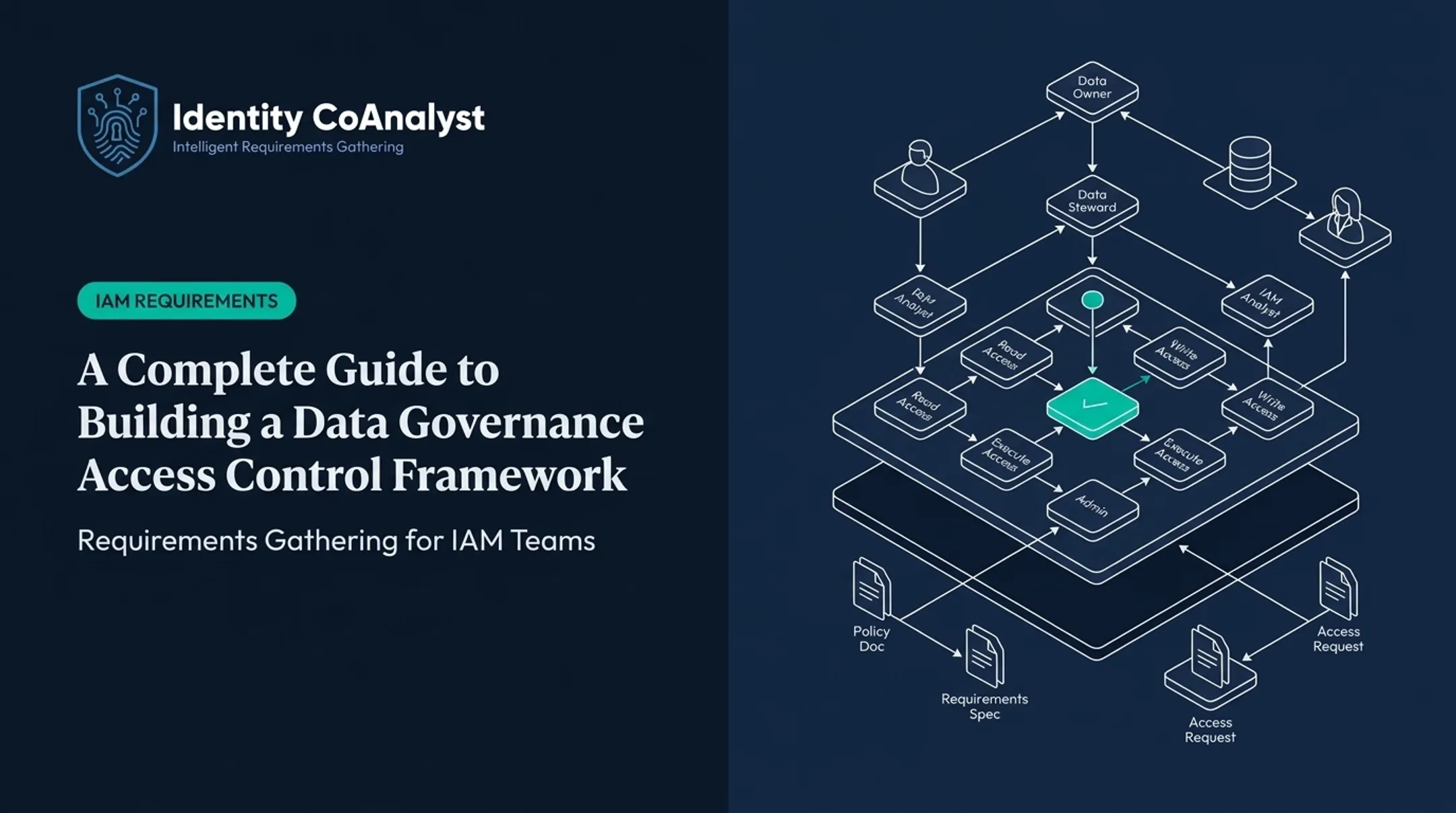

The consequences show up fast. Audit findings pile up. Privilege creep goes unnoticed for years. And when a breach hits, the average cost now sits at $4.4 million globally (IBM Cost of a Data Breach Report 2025).
This guide breaks down what access governance actually is, how it differs from access management, the components a real framework needs, and the steps to build one that survives an audit.
Key Takeaways
- Access governance is the policy and oversight layer; access management is the technical execution layer beneath it
- Strong frameworks rest on documented policies, least privilege, scheduled reviews, and continuous monitoring
- Requirements gathering is the step most organizations underestimate, and the point where projects most often stall
- SOX, HIPAA, and GDPR compliance depend on demonstrable, auditable governance practices more than technical controls alone
What Is Access Governance?
Access governance is the discipline of overseeing and regulating who can access your organization's systems, applications, and data — and why they need it. It is a set of policies, processes, and oversight mechanisms—not a single product—that make access decisions consistent, defensible, and reviewable.
It covers two related tracks:
- User access governance — who can access which systems and applications
- Data access governance — how sensitive data is classified, accessed, and protected regardless of which system holds it
The goals are straightforward: enforce least privilege, satisfy compliance requirements, and reduce the odds that one compromised account turns into a full-blown incident.
Why This Has Gotten Harder
The human element was involved in 68% of breaches in Verizon's most recent Data Breach Investigations Report, which analyzed over 10,000 incidents across 94 countries (Verizon 2024 DBIR). Compromised credentials remain the top initial attack vector in IBM's breach research.
Cloud sprawl, SaaS proliferation, and a growing population of non-human identities — service accounts, APIs, AI agents — have multiplied the number of access points organizations need to govern. Manual spreadsheets and quarterly email reminders don't scale to that.
Access Governance vs. Access Management: Key Differences
These terms get used interchangeably. They shouldn't be.
Access management (IAM) handles the technical mechanics: authentication, authorization, single sign-on, and provisioning. It's the plumbing that grants or denies access in real time. NIST describes IAM as ensuring "the right people and things have the right access to the right resources" (NIST).
Access governance is the strategic layer above it. It sets the rules IAM enforces and the evidence auditors expect:
- Defines who should have access and under what conditions
- Runs periodic certifications and access reviews
- Produces the audit trail that proves compliance
How They Work Together
Management executes access decisions; governance sets and verifies the rules:
| Function | Access Management | Access Governance |
|---|---|---|
| Grants access | ✅ | ❌ |
| Defines who should have access | ❌ | ✅ |
| Runs certification campaigns | ❌ | ✅ |
| Handles SSO/authentication | ✅ | ❌ |
| Produces audit evidence | Partial | ✅ |

Where IGA and PAM Fit
Two adjacent terms often cause confusion:
- IGA (Identity Governance & Administration) — Gartner defines it as managing the identity lifecycle and governing access across on-premises and cloud systems. It's essentially governance plus administration in one category.
- PAM (Privileged Access Management) — a subdomain focused specifically on monitoring and controlling privileged accounts, like admin credentials.
In practice, access governance is the operating model; IGA and PAM platforms are how most organizations implement parts of it.
Core Components of an Access Governance Framework
An access governance framework is a working system of interlocking mechanisms—not a policy PDF parked in SharePoint. Six components do the real work:
Access Policies
Documented rules for granting, reviewing, and revoking access. NIST SP 800-53's AC-2 control requires organizations to authorize access based on documented usage needs and to notify account managers when access is no longer required.
Role-Based and Attribute-Based Access Control
RBAC assigns permissions based on job function; ABAC adds context (location, device, time) to the decision. Both replace one-off, ad hoc grants with structured logic.
Access Certification and Reviews
Scheduled audits of who has access to what. These catch:
- Stale accounts from former employees
- Privilege creep from role changes
- Entitlements nobody remembers granting
Segregation of Duties (SoD)
NIST frames SoD as addressing "the potential for abuse of authorized privileges" by preventing conflicting permissions—like the same person approving and processing a payment.
Audit Trails and Reporting
Evidence of who approved, changed, or revoked access, and when. This is what auditors actually ask for.
Continuous Monitoring and Risk Analytics
Real-time flagging of anomalous or excessive permissions—orphaned accounts, toxic combinations, outlier entitlements—rather than waiting for the next quarterly review to catch a problem.

Steps to Build and Implement an Access Governance Framework
Step 1: Discover and Inventory Everything
Start with a full inventory of systems, applications, and data repositories, including cloud and SaaS assets that IT may not officially track. Capture owners, data sensitivity, and how access is granted today. Assets left off the inventory stay outside the control of the framework.
Step 2: Gather Detailed Access Requirements
This is where most governance and IGA projects lose momentum. Interviewing dozens of stakeholders across business units and IT, then reconciling answers in spreadsheets, is slow and error-prone. Traditional IAM/IGA/PAM discovery commonly runs 8 to 16 weeks, with a representative benchmark around 12 weeks when multiple consultants coordinate the work. Identity CoAnalyst targets this bottleneck. Instead of scheduling interviews and chasing spreadsheet responses, stakeholders complete guided conversational questionnaires asynchronously and in plain language. The platform is designed to compress weeks of coordination into days:
- More than 500 practitioner-written questions across 11 identity domains
- AI that adapts each conversation based on prior answers
- Automatic flagging of cross-department contradictions (for example, Finance and HR defining "contractor" differently)
- Auto-generated, implementation-ready requirements documentation

Step 3: Define Roles, Policies, and Least-Privilege Entitlements
Using the documented requirements, build role definitions and policies grounded in actual need, not historical assumption. Map birthright access, separation-of-duties rules, and entitlement bundles so joiners and transfers receive only what the role requires.
Step 4: Implement Certification Cycles
Set up recurring, automated access reviews rather than one-off cleanups. Manual certification campaigns cause review fatigue and rubber-stamping. Risk-based schedules, clear reviewer ownership, and actionable revoke workflows keep certifications meaningful.
Step 5: Monitor Continuously and Refine
Roles change, systems get added, and regulations shift. Track orphaned accounts, excess entitlements, and review completion rates, then feed findings back into role design. Treat the framework as living, not a project with an end date.

Best Practices for Access Governance
Adopt an "assume breach" mindset. NIST's Zero Trust Architecture (SP 800-207) starts from the premise that network location alone never earns trust. Design controls that limit blast radius. Assume something will get compromised, and make sure it can't reach the rest of the environment.
Apply least privilege rigorously, and revisit it. NIST's AC-6 control calls for periodic review of user privileges, not a one-time grant. Job roles shift constantly; access should shift with them.
Extend governance to non-human identities. Service accounts, APIs, and AI agents increasingly touch sensitive data, and they don't show up in HR systems or have a natural "owner." Common risks include:
- Accounts with no assigned owner
- Unclear lifecycle rules for deprovisioning
- Sprawl from forgotten integration or batch-job accounts
Treat non-human identities as a distinct category with mandatory ownership and regular orphan-account reviews.
Make documentation audit-ready from day one. Reconstructing evidence right before an audit is stressful and error-prone. Build the audit trail (who approved what, when, and why) as a byproduct of normal operations, not a scramble.
Frequently Asked Questions
What is access governance?
Access governance is the practice of overseeing and regulating who can access an organization's systems and data, and confirming that access aligns with least privilege and compliance requirements. It's the policy and oversight layer, not the technical mechanism.
What is the difference between access management and access governance?
Access management handles the technical execution — authentication, authorization, and provisioning. Access governance is the oversight layer that sets policy, runs certifications, and proves compliance.
What are the 5 steps of access control?
The five steps commonly cited are identification, authentication, authorization, provisioning, and review/revocation. NIST treats identification/authentication and audit/accountability as related but separate control families.
What are the 7 main categories of access control?
Common models include mandatory (MAC), discretionary (DAC), role-based (RBAC), rule-based, attribute-based (ABAC), identity-based, and risk-adaptive access control. Most organizations combine several of these to match risk tolerance and compliance needs.
How often should organizations conduct access reviews?
Most regulations require "regular" or "periodic" review without specifying an exact number. Industry practice for SOX-scoped financial systems is typically quarterly; HIPAA and GDPR require ongoing review aligned to risk.
Why is requirements gathering important before implementing an access governance framework?
Incomplete or inconsistent requirements create gaps that surface later as rework, failed audits, or access errors. Structured discovery that flags contradictions early reduces that risk versus spreadsheet-based interviews.