
Introduction
Compliance auditors don't ask if you have an access policy. They ask you to prove it works.
Most organizations struggle here:
- Manual provisioning creates inconsistent approvals
- Employees accumulate permissions they never use
- Offboarding lags days or weeks behind termination dates
- Disconnected applications sit outside the identity system, leaving no audit trail
The result is a compliance gap that shows up during an audit, not before it. NIST SP 800-53 AC-6 requires that users receive only the access necessary for their assigned tasks, yet many companies can't demonstrate this in practice, only in policy.
This article connects specific user access management (UAM) strategies to real compliance outcomes: least privilege, lifecycle automation, access reviews, privileged access controls, segregation of duties, and monitoring. We'll also cover how to assign ownership, build evidence into daily workflows, and structure a program before you configure any platform.
Key Takeaways
- UAM supports compliance by controlling who accesses what and producing proof that access decisions are approved and reviewed
- Strong programs combine least privilege, lifecycle automation, access reviews, privileged controls, SoD, and monitoring
- Compliance teams need defined control owners, documented exceptions, and regular testing that controls operate as designed
- Start with an inventory and risk-based requirements before selecting or configuring any IAM, IGA, or PAM platform
What User Access Management Means for Compliance
User access management covers the policies, processes, and tools used to authenticate users, authorize permissions, provision and revoke access, and monitor activity. It sounds simple. The terminology around it rarely is.
How UAM, IAM, IGA, and PAM Relate
These terms get used interchangeably, which creates confusion during audits and vendor evaluations:
- IAM is the broader discipline covering authentication, authorization, and access administration
- UAM typically refers to the operational piece: controlling user access day to day
- IGA adds governance on top: access reviews, certifications, and policy enforcement
- PAM protects elevated access, such as admin and service accounts
Definitions vary by vendor and organization. Before your compliance team commits to any framework, define the scope and control objectives explicitly in writing. Don't assume everyone in the room means the same thing when they say "IAM."
Authentication, Authorization, and Accountability
These three concepts get flattened together in casual conversation, but auditors treat them separately:
- Authentication confirms identity: an employee logs into the finance application with their credentials
- Authorization determines what they can do: role-appropriate permissions limit them to accounts-payable functions
- Accountability creates the record: a timestamped, auditable log entry ties the action back to that specific user

Miss any one of these three, and your evidence chain breaks.
Connecting UAM to Compliance Frameworks
No single control satisfies every regulation. That said, several US frameworks reference access management directly:
- SOC 2 (AICPA Trust Services Criteria) requires restricting logical access and documenting provisioning and removal
- HIPAA's Security Rule (45 CFR 164.312) requires technical access controls limiting ePHI access to authorized persons, plus audit mechanisms
- PCI DSS v4.0.1 links access restriction (Req. 7), authentication (Req. 8), and logging (Req. 10), including 12-month audit-log retention with the most recent three months immediately available
- SOX IT general controls (per PCAOB AS 2201) test access to financial-reporting programs and data
Verify current requirements against authoritative sources for your specific obligations. Frameworks change; distinguish mandatory requirements from recommended practices before you build controls around them.
The evidence principle is the throughline across all of these: every access decision needs an identifiable requester, approver, resource, permission, timestamp, business justification, and outcome. Without that, you have a policy. You don't have proof.
Core User Access Management Strategies That Support Compliance
Six strategies form the backbone of a compliance-ready access program. Each generates specific evidence auditors expect to see.
Least Privilege and Risk-Based Authorization
Access should map to the minimum permissions a role actually requires — nothing more. NIST AC-6 makes this a formal control requirement, not just a best practice.
Role-based access control (RBAC) sets a manageable baseline. Attributes such as department, employment status, device, or location then refine decisions without extra overhead on every request.
Left unchecked, permissions accumulate. Role drift happens when access gets added during a job change but the old permissions never get removed. Ponemon Institute's 2024 IAM study, surveying 571 US security practitioners, found over-privileged accounts to be a persistent risk precisely because users retain access from prior roles long after they've moved on.
Automate Joiner, Mover, and Leaver Workflows
Manual provisioning creates inconsistency. Automating account lifecycle events against authoritative HR data closes that gap.
In a SOX-scoped financial system, access might be granted within two hours of an approved request, quarterly recertification scheduled automatically, and a full audit trail produced without manual intervention. On the offboarding side, revocations for high-risk systems should finish within 24 hours of termination, not days later.
Retain this evidence for every JML transaction:
- The triggering event and effective date
- Systems changed and permissions modified
- Failed provisioning actions
- Remediation status for any exceptions

Establish Recurring Access Reviews and Certifications
Reviews only count as controls if reviewers actually make decisions. A report that gets glanced at and forwarded isn't a certification.
Match review frequency to risk:
| Access Type | Review Frequency |
|---|---|
| Privileged and high-risk access | Quarterly |
| Standard user access | Annually |
| Break-glass accounts | Monthly |
| Low-risk access | As needed |
Reviewers need three real options: approve, revoke, or modify. A SOX financial-system campaign, for instance, typically routes through a direct manager, then VP Finance or CFO, then internal audit as escalation.
Each certification decision should record the reviewer's identity, timestamp, business justification, and any resulting remediation action.
Govern Privileged, Emergency, and Third-Party Access Separately
Standing privileged access is a liability. PAM platforms address this through:
- Credential vaulting and automatic rotation
- Just-in-time elevation instead of permanent admin rights
- Session monitoring, recording, and time limits
- Approval workflows tied to specific tasks
Vendor and contractor access should include:
- A named internal sponsor
- A defined scope of systems and permissions
- A hard expiration date
- A documented offboarding trigger
Avoid indefinite standing credentials that nobody remembers to revoke. Break-glass access is different: review it retrospectively after every use, ideally monthly, rather than treating it as ordinary access.
Enforce Segregation of Duties and Manage Exceptions
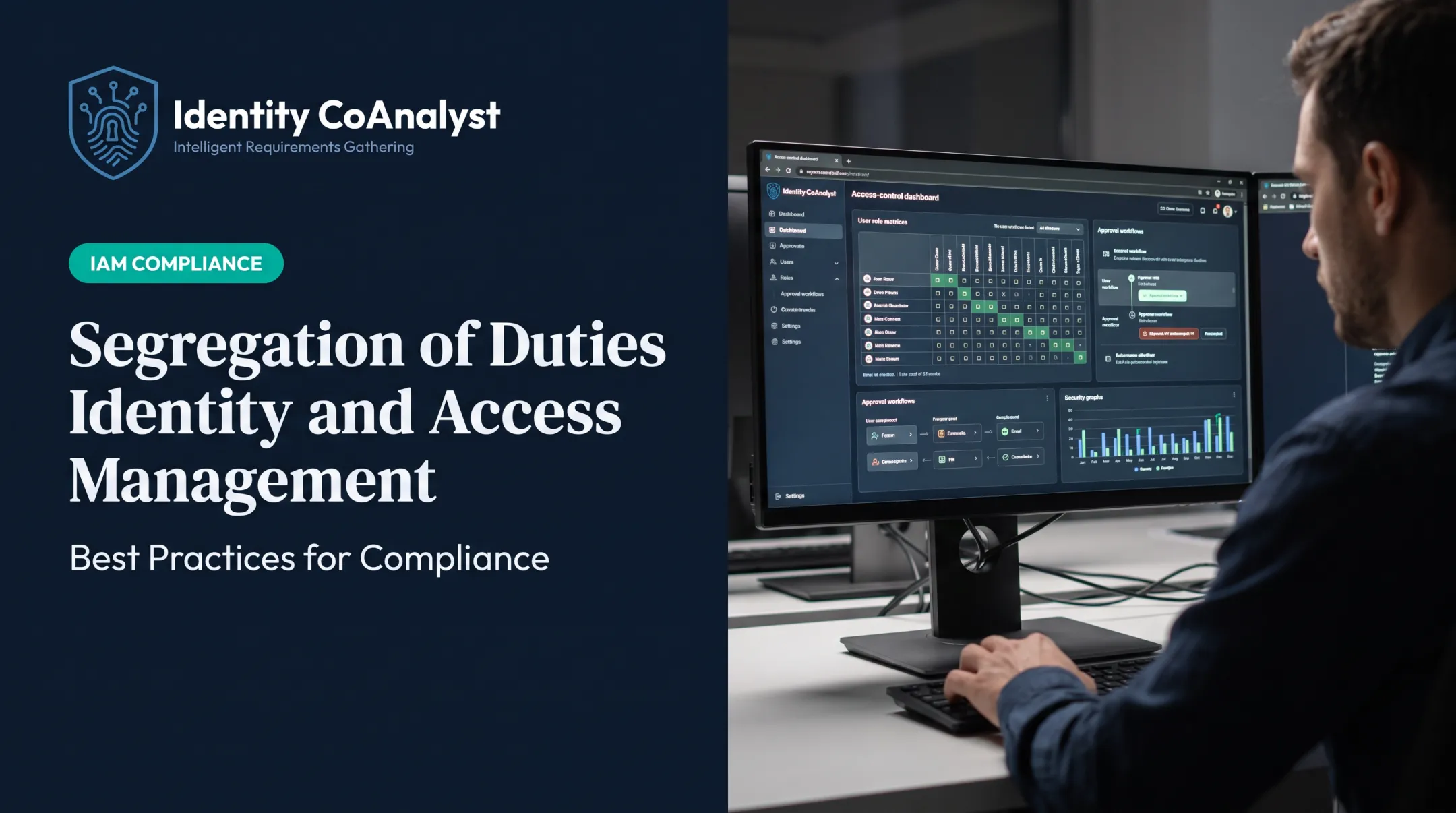
Segregation of duties (SoD) prevents any single person from both creating and concealing an error or fraudulent transaction. ISACA's implementation model uses a compatibility matrix to flag incompatible duty combinations — think "purchase requestor" and "purchase approver" held by the same person.
Two enforcement layers work together:
- Preventive checks block conflicting access at the point of request
- Detective reviews catch conflicts that slip through via role changes or manual overrides
When exceptions are genuinely necessary, ISACA's SoD implementation guidance points to documented compensating controls, defined approval authority, an expiration date, and periodic reassessment — not open-ended waivers.
Monitor Access Activity and Maintain Trustworthy Records
Centralize authentication, provisioning, certification, and privileged-activity logs wherever practical. Watch for:
- Unusual access patterns or repeated denials
- Dormant accounts with no activity in 90 days
- Privilege escalation outside approved workflows
- Access attempts after a termination date
Retention requirements vary by framework rather than one universal rule. PCI DSS specifies 12 months, while HIPAA's documentation retention rule (45 CFR 164.316) sets six years. Confirm the applicable standard before you set retention policy.
These six controls only hold up in an audit when the underlying access model, review cadence, and evidence requirements are defined up front—structured identity discovery makes that baseline explicit before tools and workflows are built.
How to Implement a Compliance-Ready User Access Management Program
Building this program in the wrong order wastes budget. Platform configuration before requirements definition is the most common mistake we see.
Start With Scope, Ownership, and an Access Inventory
Before touching any platform, inventory:
- Users, service accounts, and privileged identities
- Applications, data stores, directories, and integrations
- Third-party and vendor access points
Classify each by sensitivity, business criticality, and regulatory relevance. Then assign responsibility using a RACI model across HR, IT, security, application owners, managers, compliance, and internal audit.
Skip this step and service-account sprawl becomes a recurring finding: thousands of accounts with no clear owner and no decommissioning process.
Translate Compliance Obligations Into Testable Requirements
Regulatory language doesn't configure a system. It needs translation into specific, testable controls: approval before access, timely termination, periodic review, least privilege, privileged-session oversight.
For each requirement, define:
- Control owner and in-scope population
- Trigger, frequency, and evidence
- Exception process and testing method
Ask stakeholders directly about the messy realities: disconnected applications, temporary access, service accounts, and undocumented manual workarounds. These gaps are exactly where audit findings come from.
Use Structured Discovery Before Platform Configuration
This is where the requirements-gathering phase itself becomes the bottleneck. Traditional discovery for RBAC and IGA projects commonly runs 6 to 12 weeks of meetings, email threads, and spreadsheets. Even then, documentation is often inconsistent, with no single source of truth.
Identity CoAnalyst was built to address this specific gap. It's a vendor-agnostic discovery platform that works upstream of IGA, IAM, and PAM implementation, using AI-guided conversational questionnaires that stakeholders complete asynchronously, in plain language, without scheduling coordination.
The platform draws on a library of more than 500 practitioner-written questions across 11 identity domains, covering approval chains, joiner-mover-leaver timing, certification workflows, and SoD policy.
It automatically generates implementation-ready requirements documentation and flags contradictions or gaps between stakeholders before anyone configures a platform like SailPoint, Saviynt, or CyberArk. Use it as a planning aid alongside compliance counsel and control testing—not as a substitute for either.

Implement in Risk-Prioritized Phases
Sequence matters. Start with:
- Highest-risk applications and privileged accounts
- Terminated-user processes and offboarding gaps
- Systems containing regulated or financially significant data
From there, build foundational identity data and integrations, then lifecycle automation, access requests, reviews, role refinement, and broader monitoring. Define success criteria and rollback procedures for each phase so access changes don't disrupt operations mid-rollout.
Validate Operation, Evidence, and Continuous Improvement
Test whether access is actually granted, changed, and revoked as designed under normal, exceptional, and failure conditions. Sample-based testing that compares approved access against actual application permissions catches gaps that policy review alone misses.
Set a recurring cadence for control-owner review, internal audit feedback, and remediation tracking.
Measuring Effectiveness and Addressing Common UAM Challenges
A program without metrics is a program you can't defend during an audit.
A Balanced Metric Set
Track measures across security, compliance, and operations, segmented by application criticality and identity type so averages don't mask high-risk outliers:
- Time to deprovision: measure workforce accounts in hours, not days (per Gartner guidance)
- Review completion and remediation rates: percent of access reviews finished on time and issues closed
- Dormant-account volume: accounts flagged after roughly 90 days of inactivity
- Exception age and SoD conflict rate: how long exceptions stay open and how often duties collide
- Privileged-access session duration: actual session length versus approved time windows
Halving deprovisioning time is a practical target: faster leaver and transfer handling cuts the orphaned-access findings auditors flag most often.
Common Barriers and How to Address Them
Most UAM programs hit the same obstacles:
- Fragmented identity stores across legacy and disconnected applications
- Incomplete ownership, especially for service accounts
- Inconsistent role definitions that drift over time
- Business-user resistance to added approval steps
Phased integration, clear data ownership, and documented compensating controls address most of these. Exception governance — with expiration dates and periodic reassessment — prevents temporary workarounds from becoming permanent blind spots.
Building an Audit-Ready Evidence Package
Auditors expect to see design effectiveness and operating effectiveness, not just policy documents. Assemble:
- Current policies and access inventories
- Role and entitlement definitions
- Approval, provisioning, and deprovisioning logs
- Review results and privileged-access records
- Exception registers and remediation evidence
UAM evidence won't cover every control in every framework. State clearly what each artifact proves, and map the gaps to broader IT general controls before the audit starts.

Frequently Asked Questions
What is user access management (UAM)?
UAM controls user identities, permissions, and access across the employee or account lifecycle, from provisioning through offboarding. It supports compliance with least privilege, documented approvals, recurring reviews, and audit trails that prove access decisions were reviewed and approved.
What are common examples of user access management (UAM) tools?
Common categories include IAM and IGA platforms, directory and SSO tools, MFA and authentication services, PAM platforms, access-review tools, and workflow or provisioning integrations. The right mix depends on your specific risk profile and system landscape.
How do PAM and EPM differ in user access management?
PAM governs privileged identities, credentials, sessions, and elevated access across systems and accounts, both human and machine. EPM (Endpoint Privilege Management) focuses on removing or controlling local admin rights on individual endpoints. The two usually work together; one does not replace the other.