
Introduction
Most access-control failures aren't hacks. They're leftovers.
An employee changes teams but keeps their old permissions. A contractor's account stays active six months after the project ends. A privileged service account nobody remembers creating still has admin rights across three systems.
This is how privilege creep happens, and it's how attackers find their way into critical systems without ever cracking a password.
Role-based access control (RBAC) addresses this problem directly. But RBAC only works when it's treated as a cybersecurity and governance program, not a one-time exercise in naming roles inside a directory tool.
This guide covers:
- RBAC fundamentals and implementation planning
- Role engineering and lifecycle governance
- Separation of duties, testing, and common pitfalls
- How to choose between RBAC and attribute-based access control (ABAC)
Key Takeaways
- Permissions attach to roles, then roles to users—a manageable layer between identities and resources
- Start from business responsibilities and critical workflows, then map them to technical permissions
- Enforce least privilege, separation of duties, lifecycle automation, and continuous access reviews
- Treat RBAC as the baseline; layer ABAC when access depends on device, location, time, or data sensitivity
What Is RBAC and Why Does It Matter for Cybersecurity?
Role-based access control assigns permissions to users, contractors, and service accounts through roles rather than granting access one person at a time. Instead of an IT admin deciding, case by case, what a new hire can access, that person gets assigned to a role, and the role carries a predefined bundle of permissions.
Two terms get blurred constantly: authentication verifies who someone is; authorization (RBAC's job) determines what they're allowed to do once they're in. A stolen password is an authentication failure. Excessive access after login is an authorization failure, and it's usually the more expensive one.
The Core RBAC Relationship
The NIST reference model for role-based access control defines five connected elements: users, roles, permissions, sessions, and the assignments linking them together.
Picture a simple document-approval system:
- Viewer — can read documents only
- Analyst — can read and edit
- Approver — can read, edit, and approve
- Administrator — can do all of the above plus manage user accounts
A user might hold both Analyst and Approver roles simultaneously, activating whichever permissions the current session requires.
Why This Matters for Security
RBAC directly supports core cybersecurity principles:
- Least privilege — users get only what their job requires
- Reduced blast radius — a compromised Analyst account can't approve payments or reconfigure servers
- Controlled escalation — elevating privilege requires a defined role change, not an ad hoc permission grant
- Clear accountability — audit logs show who held which role, not a scattered list of individual permissions
Three RBAC Models
- Core RBAC — straightforward user-to-role, role-to-permission mapping. Best for smaller, less complex environments.
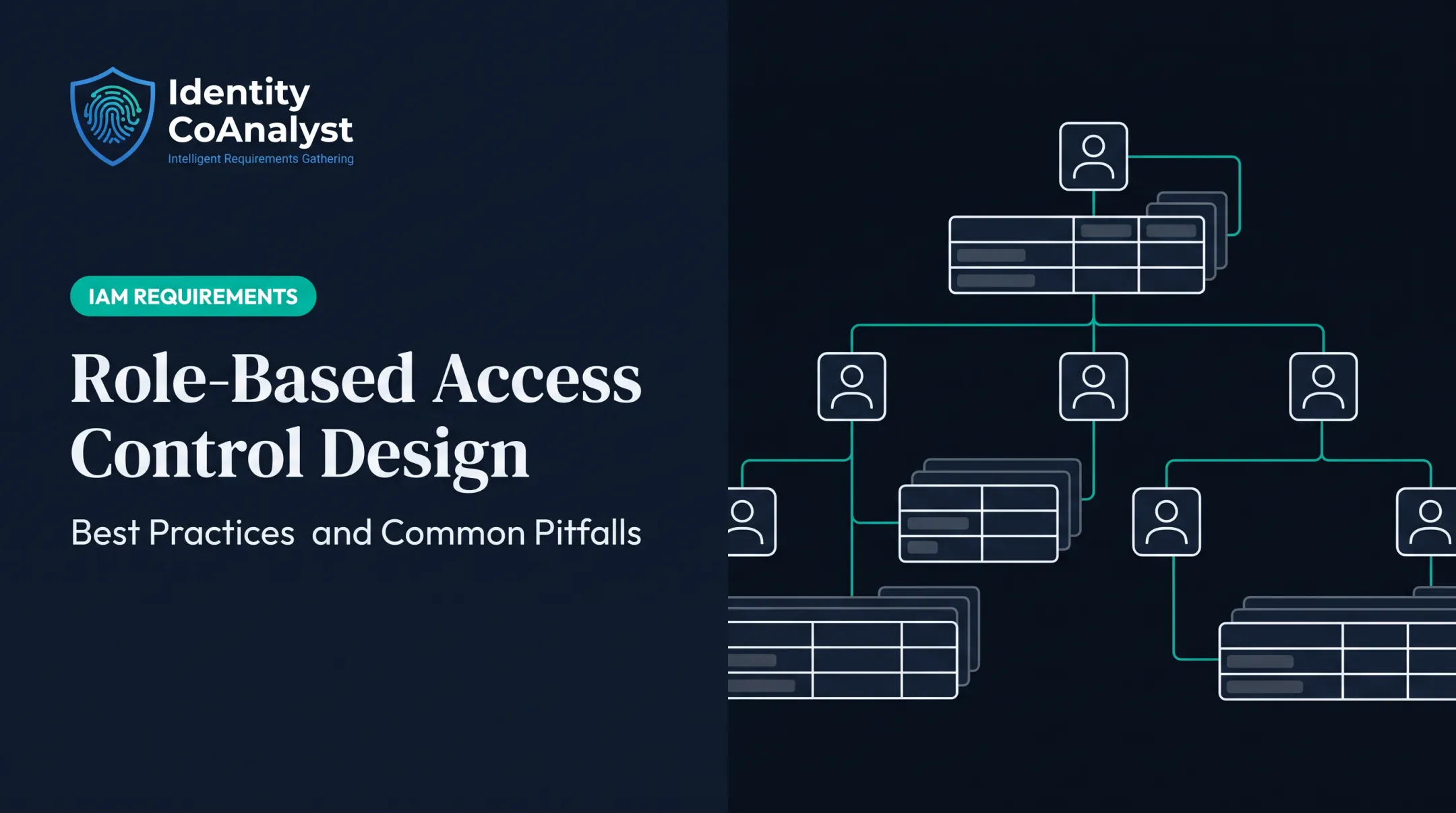
- Hierarchical RBAC — senior roles inherit permissions from junior roles. A Manager role inherits everything an Analyst role has, plus approval rights, cutting down on duplicate permission assignments.
- Constrained RBAC — adds separation-of-duties rules and mutually exclusive access, preventing conflicting roles from combining into excessive authority.

One important caveat: RBAC supports compliance evidence, but it doesn't guarantee compliance on its own. Auditors want documented ownership, access reviews, approval trails, and remediation records alongside the roles themselves.
How to Implement RBAC: A Practical Roadmap
Skipping straight to role configuration is the single most common RBAC mistake. Requirements discovery has to come first.
Start With Scope and Risk
Before designing a single role, inventory:
- Identities across employees, contractors, and service accounts
- Applications, infrastructure, and sensitive data stores
- Critical transactions and privileged functions
- Existing access-control mechanisms already in place
Gather Requirements From Both Directions
NIST's role engineering guidance describes two complementary approaches:
- Top-down — document job functions, workflows, and approval boundaries by talking to business stakeholders first
- Bottom-up — examine existing entitlements, usage patterns, and over-privileged accounts already in your systems
Most organizations need both. Top-down tells you what access should look like. Bottom-up tells you what it actually looks like, which is often uncomfortably different.
Design roles around stable business responsibilities, not individual people, temporary projects, or application menu items. A role built around "what Sarah in accounting happens to need right now" falls apart the moment Sarah changes jobs.
Map Roles to Identity Sources and Systems
Roles need to connect to your HR-driven joiner-mover-leaver process, identity provider, directories, IGA platform, SaaS applications, and legacy systems.
This is where requirements gathering typically stalls. Traditional discovery takes 8–16 weeks of meetings, emails, and spreadsheets. It often yields incomplete responses, inconsistent documentation, and missed separation-of-duties requirements.
This is the gap Identity CoAnalyst was built to close. Stakeholders answer AI-guided, vendor-agnostic questionnaires in plain language, at their own pace. The platform flags contradictions between answers and generates implementation-ready requirements documentation.
Because it sits upstream of platforms like SailPoint, Saviynt, and CyberArk, teams typically compress that 8–16-week discovery phase to under 10 days.

Roll Out Gradually and Test Before Production
- Pilot a bounded scope — one application or business unit, not the whole organization at once
- Compare proposed access against current access to catch gaps before they cause outages
- Use shadow or simulation modes where your tools support them
- Test positively and negatively — confirm allowed actions succeed, denied actions fail, inheritance behaves correctly, and revocation clears access after role changes
RBAC Best Practices for Secure, Maintainable Access
Getting roles designed correctly is half the job. Keeping them secure and maintainable for years is the harder half—and the practices below are what make that possible.
Apply Least Privilege Everywhere
Grant only what documented job duties require. NIST SP 800-53's AC-6 control requires that access remain limited to what's necessary for assigned tasks, with periodic reviews to confirm privileges still match business need. Broad administrator access should require explicit justification, not default assignment.
Keep Roles Understandable and Owned
Confusing roles create audit failures. Every role needs:
- A clear name and description
- A designated owner accountable for its accuracy
- Documented purpose, scope, and approval requirements
- Separation between business roles (what a job does) and technical roles (what a system permits)
Build in Separation of Duties
High-risk workflows need built-in conflict prevention:
- Static separation of duties prevents conflicting roles from being assigned to the same person at all. Purchase Requestor and Purchase Approver, for example, is often set up as a hard-block conflict with zero exceptions permitted.
- Dynamic separation of duties allows someone to hold multiple roles but blocks activating conflicting ones within the same session.
Some conflicts warrant flexibility rather than a hard block. Application Developer combined with Production Admin might be a soft block instead, requiring senior approval, documented business justification, and a firm expiration date on the exception, often capped around 90 days.
Automate the Identity Lifecycle
Joiner, mover, and leaver events should trigger role changes automatically, not manually. A typical workflow looks like this:
- Joiner: At hire date, create accounts and assign base access plus a department role
- Mover: Revoke the old department role immediately—not "just in case"—and require the new manager to recertify within 30 days
- Leaver: Revoke all access immediately, then schedule account deletion 60–90 days later

Review Access Continuously, Not Annually
Risk-based access reviews should catch stale roles, dormant accounts, unused entitlements, and orphaned identities well before an annual audit forces the question.
Financial-system access, for instance, often warrants:
- Quarterly certification with a strict completion deadline
- Layered reviewers (direct manager, then finance leadership, then internal audit)
- Automated removal within 24 hours of a revocation decision
Enforce Authorization on the Backend
Hiding a button in the frontend is a usability improvement, not a security control. Authorization has to be enforced at every API, database, and administrative boundary, per NIST's AC-3 access enforcement control, or a user can simply call the underlying service directly and bypass the interface entirely.
Govern Non-Human Identities
Service accounts, bots, and AI agents need the same governance as human users:
- A named owner accountable for the account
- Narrowly scoped roles, not blanket admin access
- Scheduled credential rotation and periodic review dates
- Separate, stricter controls around destructive actions
Common RBAC Challenges and How to Prevent Them
RBAC programs don't usually fail at launch. They fail two years in, once nobody's maintaining them.
Role Explosion
Creating a new role for every department, geography, or one-off exception produces hundreds or thousands of roles nobody fully understands. Sunbelt Rentals, for example, needed a 1,400-role RBAC model to support 30,000+ users during a major migration, a scale that demands deliberate structure rather than organic growth.
The fix: build stable business roles, then handle exceptions through time-limited grants or just-in-time elevation instead of permanent new roles.
Privilege Creep
Permissions accumulate because they get added constantly and removed rarely. Left unchecked, this quietly undermines least privilege across the entire environment. Regular role hygiene reviews, direct-permission audits, and mandatory approval for exceptions keep this from spiraling.
Ambiguous Roles and Ownership
Overlapping roles with unclear naming and undocumented inheritance are a leading cause of failed audits. If two roles grant nearly identical access under different names, someone eventually gets the wrong one. Assign one owner per role, enforce naming conventions, and document inheritance before any role enters the catalog.
Integration Across Heterogeneous Systems
Legacy applications with hard-coded permissions, inconsistent entitlement naming, and systems that can't consume centralized role data make cross-platform RBAC genuinely hard. Treat IGA-to-application role mapping as ongoing work: establish a shared entitlement taxonomy early and maintain those mappings as a living inventory.
The stakes here are real. According to the Identity Defined Security Alliance's 2024 survey, 84% of identity stakeholders reported that identity-related incidents directly impacted their business, up from 68% the year before. Ninety-three percent said better security outcomes, including timelier reviews of sensitive and privileged access, could have reduced that impact.

A governance operating model prevents most of this:
- Accountable role owners for every role in the catalog
- Documented change control and approval workflows
- Periodic recertification with defined exception expiry
- Metrics that measure access quality, not just role count
RBAC vs. ABAC: Choosing the Right Authorization Approach
RBAC grants access by role. ABAC evaluates attributes at decision time—who the user is, which resource they need, what action they want, and environmental factors such as location, device, or time.
ABAC typically weighs:
- Subject attributes (department, clearance, employment type)
- Resource attributes (data classification, owner, sensitivity)
- Action requested (read, approve, export)
- Environment (network, device posture, time of day)
NIST's guide to attribute-based access control notes that RBAC can be viewed as a special case of ABAC, one that specifically uses role as its defining attribute. That framing helps explain why the two aren't really competitors.
| Factor | RBAC | ABAC |
|---|---|---|
| Best for | Stable job functions, repeatable access | Dynamic, context-sensitive decisions |
| Administration | Structured, role-based | Rule-based, more flexible upfront |
| Audit evidence | Straightforward and understandable | Requires more explanation |
| Complexity over time | Manageable with governance | Can become complex to maintain |
When RBAC Alone Falls Short
RBAC alone often struggles when access depends on more than job function:
- Highly dynamic resource ownership
- Project-specific or temporary access
- Data-level (row/field) restrictions
- Fast-changing cloud environments
A Finance role that should only work during business hours from the corporate network, for example, needs an attribute-based rule on top of the role itself.
The Layered Answer
Most mature identity programs don't pick one model. They use RBAC as the baseline organizational structure, then layer in ABAC, just-in-time access, or privileged access management for the decisions that depend on context. A production-access role might grant Developer permissions, while a contextual rule restricts activation to approved change windows, with emergency access routed through a separate approval path.

Choose the mix you can govern. Use RBAC for stable job functions, then add ABAC, JIT, or PAM where context—time, location, risk, or approval state—must shape the decision.
Conclusion
RBAC succeeds or fails on the basics: accurate requirements, clear role ownership, disciplined lifecycle management, and consistent backend enforcement. The tooling matters less than most vendors suggest.
Before configuring anything, take three steps:
- Assess your current access landscape
- Identify critical workflows and conflicting privileges
- Document detailed role requirements for a defined pilot scope
That discovery phase determines whether your RBAC program becomes a governance asset or another audit finding.
If your team faces weeks of stakeholder interviews and spreadsheet reconciliation, Identity CoAnalyst was built to accelerate that phase. It turns scattered stakeholder input into structured, implementation-ready requirements before you touch a configuration screen.
Frequently Asked Questions
What is role-based access control (RBAC)?
RBAC is an authorization model where users receive permissions through assigned roles rather than individual, ad hoc grants. It differs from authentication, which verifies identity; RBAC decides what an already-authenticated user can do.
What are the three primary rules for RBAC?
Users must be assigned to appropriate roles, roles must be authorized with specific permission sets, and permissions can only be exercised through active role assignment during a session. Together, these rules enforce least privilege and controlled access.
Which is better, RBAC or ABAC?
Neither is universally better. RBAC suits stable, job-based access needs, while ABAC adds contextual, fine-grained decisions based on attributes like time or location. Many organizations combine both.
How do you implement RBAC in an organization?
Start with an inventory of identities and systems, gather business and technical requirements, design roles, map them to permissions, and roll out in a phased pilot. Follow with lifecycle integration, testing, monitoring, and recurring access reviews.
What are the most important RBAC best practices?
Prioritize least privilege, clear role ownership, separation of duties, and backend enforcement. Pair these with lifecycle automation, exception expiry dates, detailed logging, and periodic access certification.