
A contractor keeps admin rights six months after their contract ends. A former employee's Salesforce login still works. A vendor with "temporary" database access has had it for two years.
Identity-related risk is not theoretical. A 2022 survey by the Identity Defined Security Alliance found that 84% of organizations experienced an identity-related breach in the prior year, with 78% reporting direct business impact from it.
A data access control policy is the documented framework that decides who can access which data, what they're allowed to do with it, under what conditions, and how often that access gets reviewed. This article breaks down the essential elements, how to implement them, which access models fit which environments, and how to keep the whole thing from going stale.
Key Takeaways
- An effective policy ties data classification and ownership to defined roles, permissions, approvals, and reviews
- Least privilege, separation of duties, strong authentication, and time-bound exceptions form the safeguard core
- Writing the policy is step one. Enforcement, monitoring, and evidence collection make it real
- Requirements discovery should happen before anyone configures an IGA, IAM, or PAM platform
Why an Effective Data Access Control Policy Matters
Without a written policy, access decisions default to whoever's making them that day. A manager approves a request because it's faster than pushing back. An admin copies permissions from a similar role instead of scoping them correctly. Multiply that across thousands of users, and you get access creep, the slow accumulation of permissions nobody actively decided to grant.
A documented policy replaces ad hoc judgment calls with consistent rules. Sensitive financial data, patient records, and source code repositories each get handled the same way every time, regardless of who's approving the request.
Compliance and Audit Readiness
Documented access decisions matter because regulators and auditors want to see them. Several frameworks address data access directly:
- HIPAA Security Rule — requires technical policies limiting electronic health information access to authorized persons (45 CFR 164.312(a)(1))
- NIST SP 800-53 — governs account management, review frequency, and alignment with personnel transfers and terminations
- PCI DSS — sets specific requirements for cardholder-data access, including default deny and unique user IDs
- SOX-related IT general controls — cover access to financial reporting systems and change management
- State privacy laws like California's CCPA — require reasonable security procedures appropriate to the data's sensitivity

None of these frameworks guarantee compliance on their own. A written policy is the foundation auditors expect to see, not a substitute for actually enforcing it.
Operational Benefits
Beyond audits, a clear policy speeds up daily operations:
- Faster joiner-mover-leaver processing when roles are pre-mapped to entitlements
- Fewer escalations because approval paths are already defined
- Better accountability since every grant traces back to a named owner
- Fewer work stoppages when inconsistent permissions block legitimate access
Key Elements of an Effective Data Access Control Policy
A policy document needs six components working together. Skip one, and enforcement gets inconsistent fast.
Purpose, Scope, and Applicability
Define exactly what the policy covers before writing anything else. Name every asset and population in scope:
- Data types, applications, databases, and cloud services
- Endpoints and environments
- Employees, contractors, vendors, service accounts, and privileged identities
Data Classification and Ownership
Every data set needs a sensitivity tier and a named owner. Ownership determines who signs off on access requests and which controls apply. Financial systems, for example, commonly require CFO plus Compliance approval, not just a manager's signature.
Identities, Roles, Permissions, and Allowed Actions
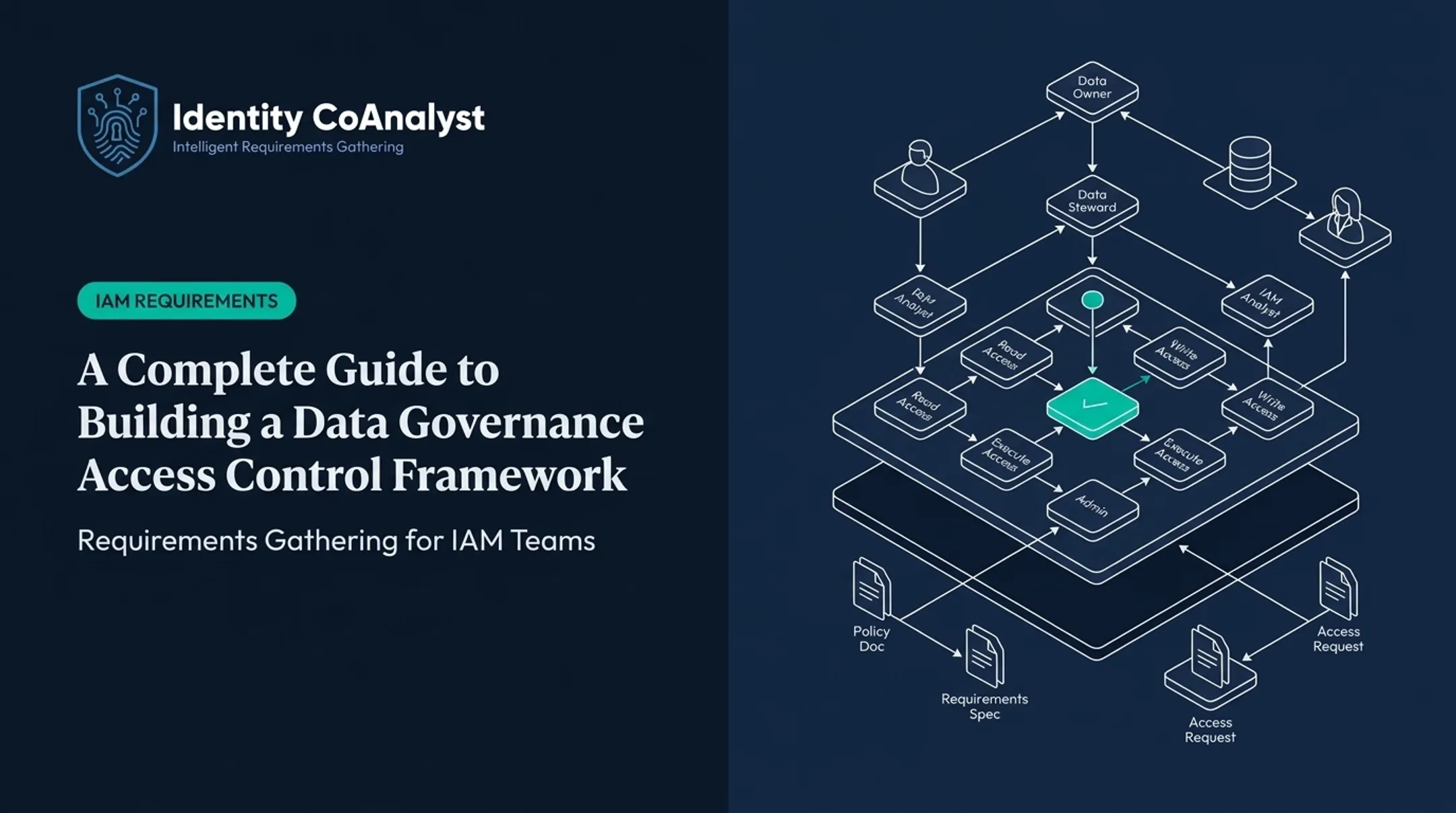
Map business roles to specific resources and actions, distinguishing between:
- Standard access: day-to-day permissions tied to job function
- Privileged access: administrative or elevated rights
- Emergency access: break-glass accounts for crisis scenarios
- Read-only access: view permissions without modification rights
Also call out shared privileged accounts and human privileged users so ownership and monitoring rules are explicit.
Governing Principles and Access Conditions
Bake these principles into the policy text, not just the technical config:
- Least privilege: restrict access to the minimum necessary for current duties
- Default deny: no access without explicit approval
- Separation of duties: no single person controls both request and approval for high-risk actions
- Strong authentication: multi-factor authentication for sensitive systems and remote access
Context matters too. Healthcare break-glass access, for instance, might only be available during on-call hours from an approved hospital network.
Access Lifecycle and Approval Workflows
Document how access moves through its entire life:
- Request and justification
- Approval and provisioning
- Transfer and temporary elevation
- Suspension and removal
A department transfer should immediately revoke old-role access while requiring the new manager to recertify remaining permissions within a defined window.
Accountability, Exceptions, and Evidence
Assign clear ownership: data owners approve access to their data, security reviews privileged grants, and HR triggers offboarding events.
Every exception needs more than an open-ended workaround:
- Documented business reason
- Expiration date
- Compensating control

How to Create and Implement the Policy
Writing policy language before understanding your environment produces documents nobody can actually enforce. Discovery comes first.
Start With Discovery, Not Drafting
Before anyone writes a policy sentence, map the terrain:
- Inventory data stores and applications across cloud, on-premises, and third-party systems
- Trace sensitive data flows to see where high-risk information actually moves
- Map user populations to business roles, not just job titles
- Document current entitlements as they exist today, warts and all
- Flag orphaned, excessive, or shared access that's accumulated over time
Every access requirement should answer seven questions:
- Who needs it
- What system
- What permission level
- Who approves it
- How it's provisioned
- How it's reviewed
- How it's removed
A requirement missing any of those seven is incomplete.
Translate Requirements Into Enforceable Decisions
Generic policy language ("employees get appropriate access") doesn't hold up during an audit. Specificity does. Consider four examples:
- Employee: standard portal access, manager approval, two-day SLA
- Contractor: time-bound access tied to contract dates, automatic revocation on expiration
- Privileged administrator: multi-level approval, enhanced justification, quarterly certification
- Service account: documented ownership, no standing human login, periodic ownership verification
Select the Right Access Control Model
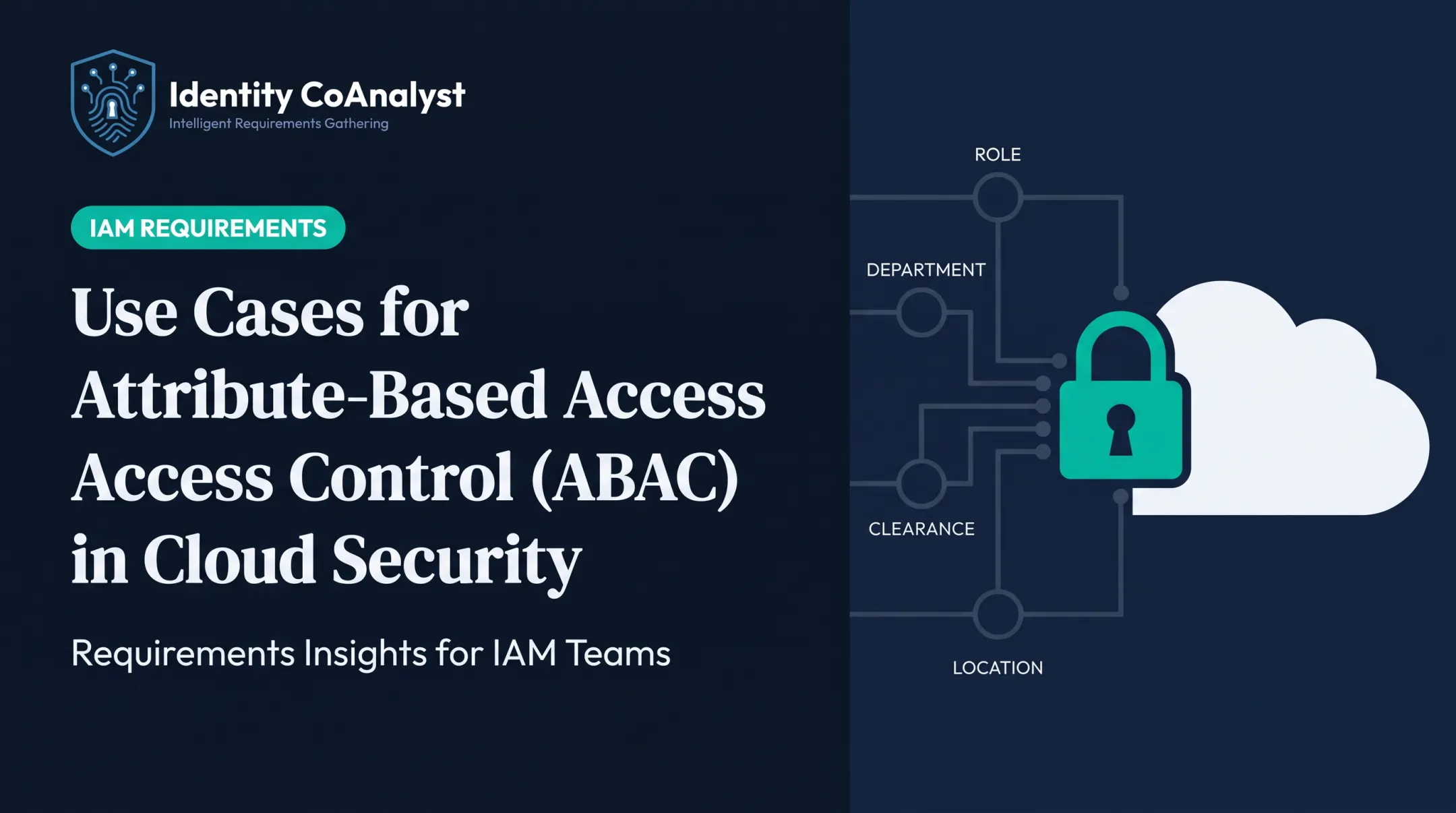
RBAC works well for stable job functions. ABAC handles situations where access depends on context: data sensitivity, device compliance, location, or time of day. Most environments need both, plus ACLs for resource-level grants and centralized identity governance tying it together. Treating any single model as universal creates gaps.
Choosing that mix only works if discovery has already aligned the people who own the data, the risk, and the systems. That is where the work gets genuinely difficult. Stakeholders across IT, security, compliance, and business units rarely agree on scope, and contradictions between departments often surface late—usually during implementation.
Identity CoAnalyst, built by CTI Global, addresses that gap. Its AI-guided, vendor-agnostic questionnaires walk consulting teams and organizations through structured discovery, surfacing gaps and contradictions before configuration begins.
The platform generates implementation-ready documentation teams can hand off when configuring SailPoint, Saviynt, Okta, or CyberArk. It sits upstream of those platforms in the requirements phase, not as an enforcement layer.
Roll Out, Validate, and Communicate
- Pilot new controls on high-value systems first
- Test normal access paths and exception scenarios
- Confirm provisioning and deprovisioning behave as designed
- Train the approvers who will live with the policy daily
- Document what remains unresolved instead of calling the rollout flawless

Choose the Right Access Control Approach for the Environment
An access control list (ACL) records which identities or groups can perform which actions on a single object. RBAC, ABAC, MAC, and DAC sit one layer up: they define how access decisions are structured across the whole environment, not just one resource.
- MAC enforces centrally defined labels and rules; users cannot override them (common in high-assurance or government settings)
- DAC lets resource owners grant or revoke access themselves, which is flexible but harder to govern at scale
RBAC vs. ABAC in Practice
| Factor | RBAC | ABAC |
|---|---|---|
| Best for | Stable job functions | Context-dependent access |
| Decision basis | Predefined role | Attributes (user, device, time, location) |
| Common risk | Role explosion | Policy complexity |
| Maintenance | Lower once roles are set | Higher, but more flexible |
RBAC assigns permissions by organizational role rather than to individuals. That works cleanly until access must vary by time, location, or device posture.
ABAC extensions layer those dynamic conditions on top of role assignments. Most mature policies end up hybrid: RBAC for the baseline, ABAC for the exceptions.
That hybrid choice matters even more once cloud apps, vendors, and non-human identities enter the picture.
Modern and Complex Environments
Cloud and SaaS permissions, privileged access, third-party vendors, and non-human identities each introduce their own wrinkles:
- Service account sprawl — thousands of accounts with unknown owners linger unless ownership is assigned and reviewed
- Third-party vendor access should include time-limited grants, full session recording, and automatic revocation at contract end
- Legacy applications often can't support modern attribute checks, forcing compensating controls elsewhere
Watch for role explosion: dozens of narrow, overlapping roles usually mean teams are forcing RBAC to handle context it was not designed for. Shift that context into ABAC, keep RBAC as the baseline, and use compensating controls where legacy systems cannot evaluate attributes.
Keep the Policy Effective Over Time
A policy that isn't reviewed becomes fiction within a year. Roles change, applications get replaced, and regulations shift, none of which a static document accounts for on its own.
Continuous Monitoring
Log access events, failed requests, privilege changes, and administrative actions on a consistent schedule. Reviewers need that trail to investigate anomalies instead of guessing. Break-glass and emergency access deserve tighter scrutiny than standard grants, given how easily they get abused.
Access Certifications and Review Cadence
Review frequency should be risk-based, not arbitrary. PCI DSS's official v4.0 requirements specify that user accounts and related privileges get reviewed at least every six months for job-function appropriateness. NIST takes a different approach, leaving review frequency organization-defined rather than fixed.
A practical structure many organizations land on:
- Standard access: annual review by the manager
- Privileged and financial access: quarterly review
- Break-glass accounts: monthly verification
- Contractor access: reviewed before every contract renewal

Trigger additional reviews after reorganizations, application changes, security incidents, or regulatory updates. Don't wait for the calendar if something material has already changed.
Measuring Policy Health
Track indicators that reveal whether the policy is actually working:
- Stale or dormant accounts with no recent activity
- Excessive privileges flagged during certification
- Unresolved exceptions past their expiration date
- Approval turnaround time against your defined SLA
- Deprovisioning completion rate after offboarding
Feed those findings back into role design, approver training, and workflow changes. Treat the metrics as the operating loop that keeps the policy current—not a report that gets filed and forgotten.
Frequently Asked Questions
Can you give me an example of an access control policy?
In a finance app, standard users get view-only access approved by the data owner, and MFA is required at login. Access updates automatically on department transfers, actions are logged, and quarterly recertification covers time-limited exceptions with documented justification.
What are ACL policies?
An access control list records which specific users or groups can perform which actions on a resource, like a file or database table. Unlike enterprise-wide models such as RBAC or ABAC, an ACL operates at the individual resource level rather than governing access decisions across an entire system.
What should be included in a data access control policy?
Purpose and scope, data classification and ownership, roles and permissions, authentication requirements, lifecycle workflows, monitoring and logging, exception handling, assigned responsibilities, and review requirements. Missing any of these creates enforcement gaps down the line.
How does least privilege apply to data access?
Users should get only the minimum data and actions their current role requires, nothing extra "just in case." Temporary or elevated access needs explicit justification, approval, active monitoring, and removal the moment it's no longer necessary.
How often should a data access control policy be reviewed?
Review frequency should match risk level rather than follow a fixed universal number. High-risk and privileged access typically warrants quarterly review, while standard access might work on an annual cycle, with additional reviews triggered by organizational, technical, or regulatory changes.