
This is normal. Successful Agile delivery depends on continuous discovery, clarification, and validation, not a one-time requirements handoff at project kickoff.
This article is written for Agile product owners, developers, delivery leads, and business analysts, including teams building complex enterprise identity, security, or regulated software. We'll cover how Agile requirements gathering actually works, the techniques that make it effective, documentation and traceability considerations, common failure points, and when a project needs more formal controls layered on top.
Key Takeaways
- Treat requirements gathering as continuous work from vision through backlog refinement, development, and validation.
- Blend stakeholder conversations with story mapping, Three Amigos sessions, prototypes, and sprint reviews.
- Specify only enough detail to build and test, while leaving room to change.
- Add traceability, baselines, and change control for regulated work without reverting to upfront specs.
What Is Agile Requirements Gathering and Why Does It Matter?
Agile requirements gathering is the ongoing practice of discovering, clarifying, prioritizing, documenting, and validating what a solution needs to do. It runs throughout the delivery lifecycle rather than once at the start. It's related to, but distinct from, several neighboring practices:
- Requirements management is the governance layer: baselines, version history, approvals.
- Requirements writing is the craft of turning a need into a clear statement.
- Backlog refinement is the recurring ceremony where the team adds detail to items already captured.
- Solution design happens after requirements are understood well enough to build against.
Agile requirements gathering feeds all four. It's the discovery engine underneath them.
Progressive Elaboration, Not Guesswork
Waterfall projects try to lock requirements at the start and treat every later change as scope creep. Agile takes a different position: requirements are progressively elaborated. Teams add detail as they learn more, refining backlog items during and between iterations rather than trying to finalize everything upfront.
Three categories of requirements show up in nearly every Agile project:
- Known requirements — captured early through interviews, workshops, and existing documentation.
- Overlooked requirements — real needs that discovery missed, often surfacing during development or testing.
- Emergent requirements — needs that only become visible once users interact with a working increment.
Ignoring any of these categories carries real cost. PMI's research on requirements management found that 47% of unsuccessful projects fail to meet their goals because of inaccurate requirements management. A related PMI study put the figure at 37% of organizations citing inaccurate requirements as a primary cause of project failure.

Rather than locking everything upfront, build a process that keeps discovering, testing, and adjusting requirements as the team learns.
How Agile Requirements Gathering Works
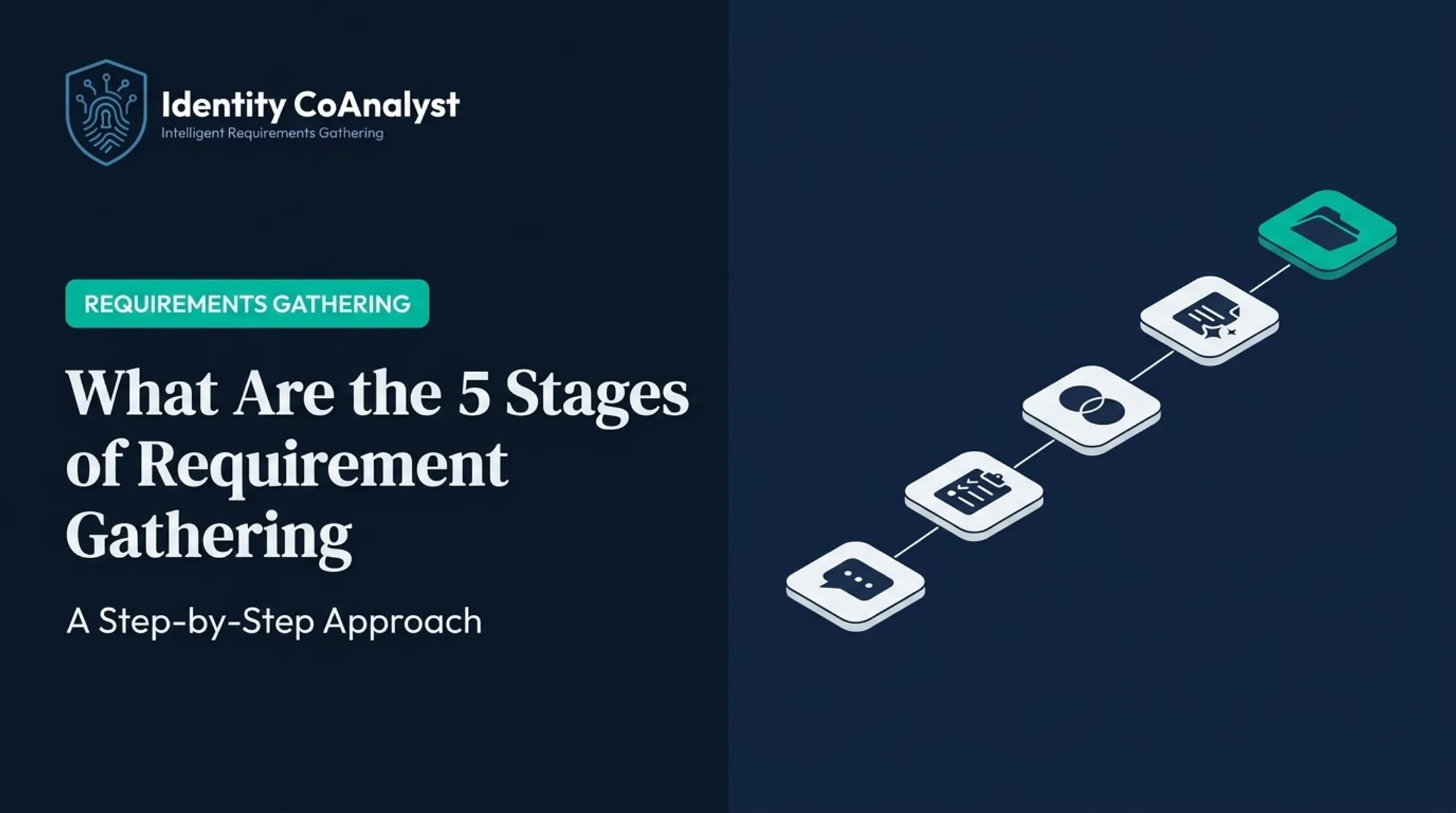
The end-to-end flow runs from product vision through backlog creation, prioritization, refinement, development, validation, and feedback-driven updates. It's cyclical, not linear.
- Identify stakeholders and constraints. Map users, decision-makers, business goals, dependencies, and success measures. Pull in business, technical, security, compliance, operations, and support perspectives early, not after the backlog is already written.
- Elicit and organize needs. Use interviews, observation, workshops, questionnaires, existing-system reviews, and journey maps. Document current-state workarounds too—a spreadsheet fix staff have used for years is often a requirement hiding in plain sight. Track assumptions, open questions, and conflicting opinions rather than smoothing them over.
- Translate discoveries into backlog items. Turn findings into epics, features, user stories, non-functional requirements, and acceptance criteria, plus supporting prototypes or models where useful. Describe the need, not the implementation.
- Prioritize and refine. Rank items by business value, risk, dependencies, feasibility, and learning potential. An item is ready for sprint planning when the outcome is clear, acceptance criteria are testable, and dependencies are visible.
- Validate and update. Confirm requirements through examples, tests, prototypes, sprint reviews, and demonstrations. Feed what you learn back into the backlog, and keep a record of why decisions were made.
A Practical Example: Identity Access Requirements
Consider a vague starting need: "improve employee access." On its own, that phrase can't be built or tested. Working through the flow above turns it into something concrete:
- Joiner workflow: When a Workday record moves to Active status, an Active Directory account is created, email is provisioned, and a baseline "Employee - Base Access" role plus a department role are assigned.
- Mover workflow: A department change immediately revokes the old department role, assigns the new one, and triggers recertification by the new manager within 30 days.
- Leaver workflow: A termination-date update revokes all access and disables accounts immediately, forwards email to the manager for 30 days, and schedules account deletion at day 90.
- Access requests and approvals: A request for a sensitive role, like Marketing Automation Admin, routes to a specific approver, such as the requesting employee's director, with a defined turnaround.
- Certification: Access tied to role or department change requires a documented, time-bound review.

That's what "progressive elaboration" looks like in practice. A one-line goal becomes five testable workflows with owners, timing, and approval logic attached.
Essential Requirements-Gathering Techniques for Agile Teams
No single technique captures everything a team needs to know. Combining a handful of methods, applied deliberately, works better than leaning on one.
Interviews, observation, and open-ended questioning. Ask how someone actually does their job today, not just what feature they want. Watching a user work often reveals exceptions and workarounds they wouldn't think to mention in a meeting.
Cross-functional workshops and Three Amigos. The Three Amigos technique brings together business, development, and testing perspectives. The group examines a story through three lenses: the problem being solved, how it might be built, and what could go wrong. Adding security, UX, or operations voices when relevant catches edge cases before they become defects.
Story mapping and journey mapping. Laying out the user's end-to-end workflow in sequence exposes gaps and unhappy paths that a flat backlog list hides. It also helps define a sensible minimum release.
Prototyping and example mapping. Low-fidelity wireframes give stakeholders something concrete to react to. People critique a mockup far more easily than they describe a feature from scratch, which often surfaces emergent requirements before development starts.
Backlog refinement with acceptance criteria. Good stories follow the INVEST checklist: independent, negotiable, valuable, estimable, small, and testable. Behavior-driven Given-When-Then examples make acceptance criteria specific enough for developers and testers to share one definition of done.
Sprint reviews and structured feedback. Working software is itself a discovery tool. Capture stakeholder comments during a review as concrete decisions, backlog changes, defects, or new hypotheses—not meeting notes that disappear afterward.
When Stakeholders Are Distributed
Not every team can get five stakeholders in a room weekly. Blend synchronous workshops with asynchronous discovery so input quality stays high without the scheduling bottleneck:
- Guided questionnaires stakeholders complete on their own schedule
- Recorded decisions that stay visible to the whole team
- Scheduled validation sessions to confirm what asynchronous input produced
Using AI Responsibly in Requirements Gathering
Generative AI tools help with clarifying terminology, spotting missing questions, organizing scattered responses, and drafting initial requirement language. That drafting and organizing work is where the tools add the most value today. Validation and broad industrial adoption are still less proven.
That distinction matters. Treat AI output as a draft, not an approved requirement. Human review, data protection for sensitive stakeholder input, and clear accountability for final decisions still belong with the product owner and delivery team.
Key Factors, Common Issues, and When Agile Gathering Needs Additional Controls
Who Needs to Be in the Room
Requirements quality depends heavily on who contributes. A team should hear from:
- The product decision-maker, not just senior stakeholders who approve budgets
- Subject-matter experts who understand day-to-day exceptions
- Actual end users, not just their managers
- Technical team members who can flag feasibility issues early
- Security or compliance representatives on sensitive initiatives
- Someone who knows the operational realities, like support staff handling tickets
What Makes a Requirement Good
A strong requirement is clear, testable, feasible, consistent with other requirements, traceable, and tied to a measurable outcome. Compare:
- Ambiguous: "The system should be fast."
- Testable: "95% of access requests must complete approval routing in under 2 seconds."
The rewrite gives developers and testers something they can actually build and verify against.
Common Failure Modes
Watch for these recurring problems:
- Treating a user story as a complete specification instead of a placeholder for a conversation
- Collecting input only from senior stakeholders, missing frontline reality
- Confusing a requested solution with the underlying need
- Skipping nonfunctional requirements like performance, security, or auditability
- Ignoring edge cases until they surface as production defects
- Letting backlog items go stale without revisiting whether they're still accurate

Balancing Lean Documentation With Necessary Evidence
Agile teams shouldn't drown backlogs in paperwork, but some environments need more than a story card. FDA guidance on software validation is explicit that requirements should be traceable to system specifications and to risk-analysis results, and that approved documentation should be archived under configuration-management control. Any later change requires analyzing its impact on the broader system before regression testing.
When to Add Controls
Additional rigor makes sense for:
- Fixed contractual scope with defined deliverables
- Complex system integrations with multiple dependencies
- High-risk security decisions
- Regulated or safety-critical systems
- Large, multi-team programs where one team's changes ripple across others
In those cases, layer on baselines, version history, impact analysis, approval records, and bidirectional traceability. Connect each requirement forward to design, implementation, and test evidence, and backward to the business need it satisfies. That is proportional governance for work where the cost of getting something wrong is high—not a retreat from Agile.
A quick readiness checklist before calling a requirement done:
- The business or user outcome is clearly stated
- Stakeholders agree on the intent, not just the wording
- Acceptance criteria are testable
- Dependencies and risks are visible
- Nonfunctional needs are captured
- The item traces to validation evidence
Where Purpose-Built Tools Fit In
Identity initiatives for governance, access management, or privileged access often pull in dozens of stakeholders and dense compliance context. Identity CoAnalyst, an AI-guided, vendor-agnostic questionnaire platform, fits upstream of that Agile work by:
- Replacing scattered interviews and spreadsheets with structured, plain-language questionnaires stakeholders complete asynchronously
- Generating draft requirements documentation from those responses
- Flagging contradictions across stakeholders—for example, two department leads describing conflicting approval rules for the same access request
That output still needs product ownership and Agile validation before it becomes an approved backlog item. The platform accelerates discovery on complex identity work; it does not replace the team's judgment.
Conclusion
Agile requirements gathering is a continuous process of learning and alignment. Documentation still matters; it evolves with the work.
The practical formula holds across projects of any size:
- Involve the right stakeholders
- Ask evidence-based questions
- Write needs as valuable, testable backlog items
- Validate against working software
- Adapt as understanding grows
Match the rigor to the risk. Lightweight practices work fine for low-risk features. Regulated systems, safety-critical software, and large contractual programs still need traceability, baselines, and formal review—layered on top of an iterative process, not swapped for a rigid, all-upfront specification.
Frequently Asked Questions
What is requirements gathering in Agile?
Requirements gathering in Agile is the continuous process of discovering, clarifying, prioritizing, documenting, and validating requirements throughout delivery, rather than finalizing them once at project start.
What are the methods of requirement gathering?
Common methods include interviews, observation, workshops, questionnaires, user story mapping, prototyping, backlog refinement, Three Amigos discussions, and sprint reviews.
What is the 3-5-3 rule in Agile?
The 3-5-3 rule is not an official Scrum standard. Scrum Inc. uses it as informal shorthand for 3 roles, 5 events, and 3 artifacts, and notes that backlog refinement isn't technically a Scrum event.
Is Agile still relevant in 2026?
Yes. Digital.ai's State of Agile report found 42% of organizations now use hybrid models, with higher rates among larger organizations. Iterative delivery and customer feedback remain valuable, especially with formal governance.
What are the 5 C's of agile management?
There's no single authoritative source for this term. Atlassian's material lists Communication, Collaboration, Commitment, Customer, and Continuous Improvement as an explanatory mnemonic, not a Scrum or Agile Manifesto standard.
What are the 5 principles of Agile methods?
The Agile Manifesto actually lists 4 values and 12 principles, not 5. Commonly cited themes include customer value, welcoming change, frequent delivery, and continuous improvement. Check the Agile Manifesto directly for the authoritative list.