
Many teams jump straight into solution mode before anyone has asked the right questions. The result? Scope creep, mid-project surprises, and rework that eats budgets alive. This guide breaks down the essential questions every requirements gathering session needs, the stages that keep projects on track, and how AI-guided tools are starting to change the discovery process entirely.
Key Takeaways
- Capture business goals, users, technical constraints, risks, and maintenance in every session
- Structure conversations with the 5Ws and 1H (Who, What, When, Where, Why, How)
- Weak stakeholder engagement and skipped non-functional requirements sink projects most often
- AI-guided questionnaires replace much of the manual interview and spreadsheet work
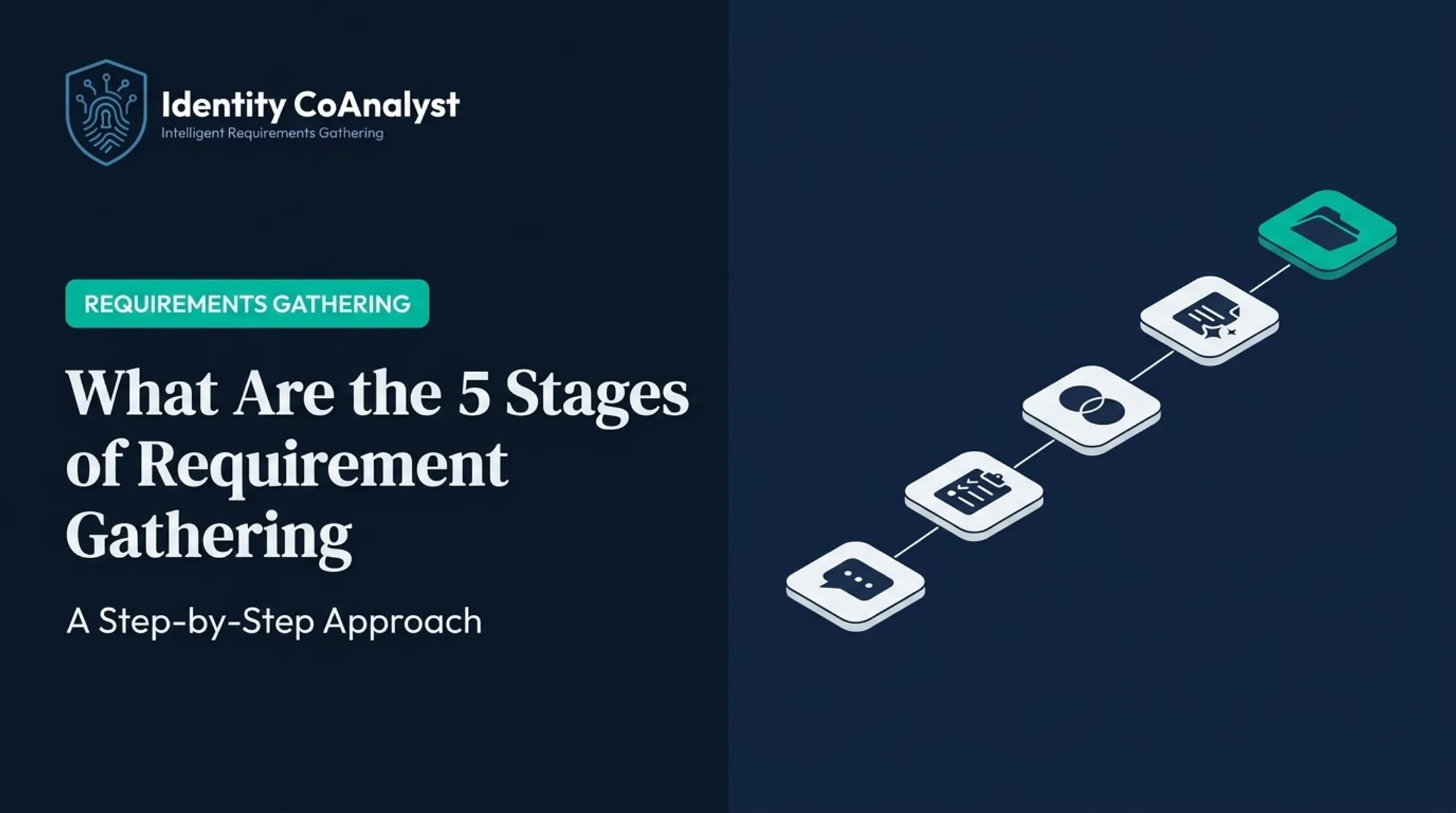
Stages of Requirements Gathering
Most requirements efforts move through these phases:
- Discovery/scoping — define the problem and project boundaries
- Stakeholder identification — map who has a voice and why
- Elicitation — interviews, workshops, or questionnaires to collect input
- Documentation — turn conversations into written, structured requirements
- Validation/sign-off — formal approval before development starts
- Ongoing refinement — adjust as new information surfaces

PMI's requirements management framework treats this as a cycle of planning, development, verification, and change management—not a one-and-done checklist. Skip a phase and the cycle breaks.
Why Skipping Stages Leads to Rework
Cutting corners early usually shows up as rework later:
- Skip stakeholder identification — an overlooked voice objects in week 10 instead of week one
- Skip validation — you build against requirements nobody formally approved
- Skip ongoing refinement — new facts never make it back into scope or design
The IIBA's BABOK guide defines requirements validation as confirming that requirements "support the delivery of expected benefits and are within solution scope."
Without that step, teams build on assumptions instead of consensus, and scope creep becomes the norm rather than the exception.
Essential Questions to Ask During Every Requirements Gathering Session
A structured question set keeps every requirements session honest about goals, users, constraints, and ownership. Work through these categories in order so gaps surface in the room—not months into build.
Business & goal-oriented questions
- What problem are we actually trying to solve?
- What does success look like, and how will we measure it?
- What's explicitly in scope, and what's explicitly out?
- What's the budget and timeline reality, not the wish list?
- What happens if this project doesn't happen at all?
Stakeholder & user questions
- Who are the primary stakeholders, and who has final decision-making authority?
- Who will actually use this day-to-day?
- What pain points are current processes creating for each group?
- Whose priorities conflict, and how should we resolve that?
Functional requirement questions
- What must the system or process do, step by step?
- What are the core workflows users will follow?
- What exceptions or edge cases need to be handled?
- What data needs to be captured, stored, or transformed?
Non-functional requirement questions
- What performance standards must be met (speed, uptime, load)?
- What security controls and operational requirements apply?
- How much does this need to scale, and over what timeframe?
- What accessibility standards are required?
Technical & integration questions
- What existing systems must this connect to?
- Where does the data currently live, and where should it live?
- What technical constraints or legacy systems limit our options?
- Who owns the systems we'll need to integrate with?
Risk, compliance & long-term questions
- What regulatory requirements apply (HIPAA, SOX, PCI-DSS, and similar)?
- Who owns this system after launch?
- How will long-term success be measured, six months and two years out?
- What happens when key stakeholders leave the organization?

Best Practices for Effective Requirements Gathering
Ask "what questions would you like answered" instead of "what do you want." The second question invites vague wish lists. The first forces stakeholders to think about actual decisions they need help making, which surfaces specific, actionable requirements instead of abstractions.
A few more habits that separate strong requirements sessions from weak ones:
- Use open-ended questions in interviews, then follow up with "why" to uncover the real business need behind a request
- Define a clear "definition of complete" with stakeholders before work begins, not after disagreements start
- Document requirements and get formal sign-off before development, aligned with PMI's standard for documented, approved acceptance
- Tailor question sets by role: business leads on ROI and timelines, end users on workflow friction, technical teams on integration constraints
Common Mistakes That Undermine Requirements Gathering
Assumptions are the enemy here. Teams that skip stakeholder interviews and rely on what they think users need almost always end up rebuilding later.
Missing voices create blind spots. A requirements session with only business stakeholders misses technical constraints. One with only technical staff misses user friction points. You need business, technical, and end-user voices represented every time.
Skipping non-functional requirements is expensive. Security, performance, and compliance needs often get treated as afterthoughts, then surface as costly fixes after launch.
Research from PMI's analysis of NASA program data found that projects investing less than 5% of total costs in the requirements process saw cost overruns of 80% to 200%. Projects investing 8% to 14% saw overruns under 60%. The requirements phase is not the place to cut corners.

How Technology Is Changing Requirements Gathering (for Identity & IT Projects)
IGA, IAM, and PAM projects are especially hard on traditional requirements gathering. Stakeholder interviews and spreadsheets commonly stretch 8 to 16 weeks—often around 12—and manual coordination across security, IT, HR, and compliance frequently leads to missed requirements.
AI-guided platforms are changing that model. Identity CoAnalyst, built by CTI Global, uses 500+ practitioner-written questions across 11 identity domains—from access certifications and RBAC to lifecycle events and privileged access.
Instead of scheduling workshops, the platform deploys structured, role-mapped questionnaires to stakeholders simultaneously. Here's what that looks like in practice:
- Stakeholders answer in plain language, at their own pace, without needing IAM jargon
- AI adapts follow-ups from each response (skip PAM questions entirely if PAM isn't in use)
- Cross-stakeholder analytics flag contradictions automatically, like Finance and HR defining "contractor" differently
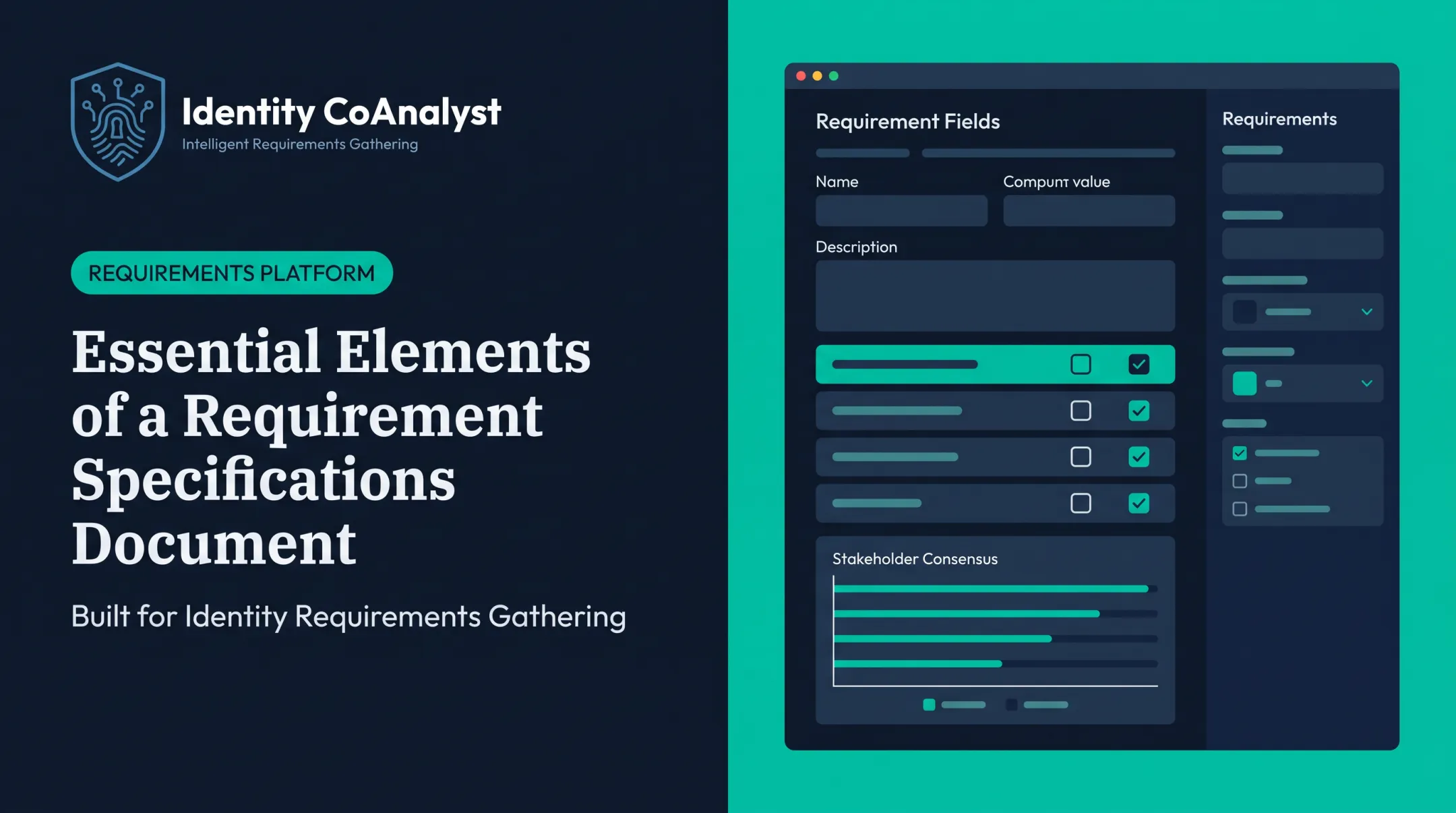
- Completed responses generate implementation-ready documentation, exportable to Word or PDF
The practical result: work that once took roughly 12 weeks and multiple consultants now compresses to under 10 days, with audit-prep documentation ready in as little as three days. Human judgment still drives the decisions—the platform removes the scheduling bottleneck and spreadsheet reconciliation that slow traditional identity discovery.
Buyers are starting to treat that capability as a selection criterion in its own right. Enterprise Security Magazine's deep dive on the requirements gap argues that executives choosing an identity partner should weigh the provider's ability to convert scattered organizational authority into clear, usable specifications before configuration begins, not just its platform credentials. Judged that way, the questions above are less a checklist than the mechanism that produces the specification.

Frequently Asked Questions
What are the stages in requirements gathering and analysis?
The core stages are discovery/scoping, stakeholder identification, elicitation, documentation, and validation/sign-off. Ongoing refinement continues throughout the project as new information emerges.
How do you gather requirements for a software project?
Software teams typically combine stakeholder interviews, collaborative workshops, and structured questionnaires, then document findings in requirements management tools. Formal review and sign-off follow before development starts.
What are the best practices for requirements gathering?
Ask open-ended questions, follow up with "why" to confirm real needs, define a clear scope boundary upfront, and get formal stakeholder validation before building anything.
What are some good questions to ask during requirements gathering?
Focus on goals ("what does success look like?"), users ("who will actually use this?"), and technical constraints ("what must this integrate with?"). See the categorized question lists above for a full breakdown.
What are some examples of questionnaires?
Structured question sets organized by category, like functional, non-functional, and technical requirements, are common. AI-guided platforms like Identity CoAnalyst offer domain-specific libraries, such as 500+ practitioner-written questions across 11 identity domains, with adaptive branching logic.